
What Is Dust-Free Demolition? The Complete Homeowner Guide
TL;DR: Dust-free demolition is a method of removing tile, flooring, and other interior materials using specialized equipment that captures dust at the exact point it is created, rather than letting it spread into the air. This is different from generic "dustless" marketing claims, which sometimes describe methods that only reduce dust rather than truly capture it at the source. True dust-free demolition keeps a home's air, surfaces, and HVAC system clean throughout a remodel project.

Key Takeaways
Dust-free demolition captures dust at the tool head the instant it is created, using vacuum systems integrated directly into grinding and chipping equipment.
The terms "dust-free" and "dustless" are often used interchangeably in casual conversation, but not all dustless methods actually capture dust at the source. Some only reduce visible dust rather than eliminate it.
Traditional demolition without source capture can release up to one pound of crystalline silica dust per square foot of material removed, a documented OSHA health hazard.
Dust-free demolition applies to tile, stone, thinset, hardwood, vinyl, carpet glue, and most other interior materials that require mechanical removal or grinding.
The equipment distinction, not marketing language, is what separates genuinely dust-free demolition from a job that simply looks cleaner on the surface.
Dust-free demolition has become a common term in remodeling and renovation conversations across Central Oregon, but the phrase means different things depending on who is using it. For some contractors, "dust-free" is a marketing description for a job that generates less visible mess than a sledgehammer approach. For others, it describes a specific engineering standard: dust captured at the source, before it enters the air at all. Understanding which definition applies to a given contractor's work is the single most useful thing a homeowner can learn before booking any demolition project.
DustFree PNW provides true source-capture dust-free demolition across Central Oregon, covering dust-free tile removal and flooring removal. Here is exactly what dust-free demolition means, how it works, and why the distinction between true dust-free and "virtually dust-free" matters for your home.
How Dust-Free Demolition Actually Works
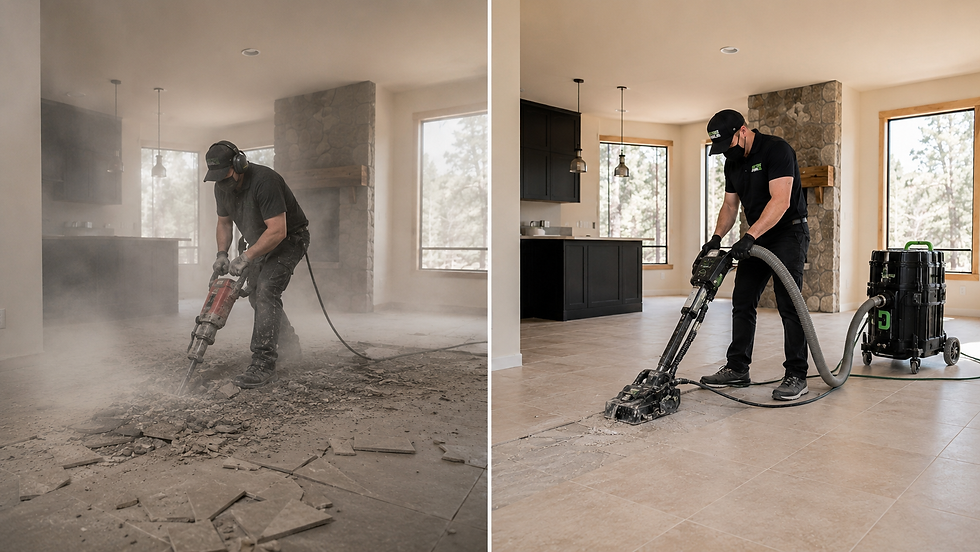
Dust-free demolition relies on source capture: a vacuum system built directly into the demolition tool itself, positioned at the exact point where the tool contacts the material being removed. As tile is chipped, thinset is ground, or adhesive is abraded, the dust generated at that instant is pulled into the vacuum system before it has any opportunity to disperse into the room's air.

This is a fundamentally different approach from placing a shop vacuum nearby or relying on plastic sheeting to contain a work zone. A vacuum sitting several feet away from the tool head captures only a portion of the dust that becomes airborne, and by the time it reaches the vacuum inlet, a meaningful amount has already spread into the surrounding air, settled on nearby surfaces, or entered the home's HVAC return. Containment methods like plastic sheeting and negative air pressure help limit where dust travels once it is airborne, but they do not prevent the dust from becoming airborne in the first place.
Method | How It Works | Dust That Enters the Air |
True source capture (dust-free) | Vacuum integrated into the tool head captures dust at the point of creation | Minimal — captured before dispersal |
Nearby shop vacuum | Vacuum runs several feet from the work area, pulling in ambient air | Moderate to high — most dust disperses before capture |
Containment and plastic sheeting | Physical barriers limit where airborne dust can travel | Contained to a zone, but still airborne within it |
Wet suppression (water misting) | Water weighs down dust particles so they fall rather than float | Reduced, but generates wastewater and mud byproduct |
No dust control | Traditional hammer and chisel demo with no containment | High — full dispersal through the work area and beyond |
The equipment used in true dust-free demolition typically pairs a diamond grinding wheel or chisel attachment with a high-airflow vacuum designed specifically for fine particulate capture, connected through sealed hose systems into a containment tank. This is meaningfully different from a standard construction shop vacuum, which is built for general debris pickup rather than continuous fine-dust capture during active grinding.
Why Dust Matters More Than It Looks
The health concern behind dust-free demolition is not aesthetic. Tile, stone, thinset mortar, and concrete all contain crystalline silica, a mineral that becomes a respirable hazard once ground into fine particulate. Traditional demolition without source capture can release up to one pound of silica dust per square foot of material removed. The Occupational Safety and Health Administration classifies airborne crystalline silica exposure as a documented cause of silicosis and other serious, irreversible respiratory illness, and has set specific exposure limits for construction environments under its respirable crystalline silica standard.
Beyond the health question, uncontrolled dust also travels further than most homeowners expect. Fine silica particles pass through standard HVAC filters, circulate through ductwork, and settle in cabinets, closets, and on furniture throughout a home, often requiring weeks of cleaning and sometimes professional duct service to fully resolve. This is the practical reason dust-free demolition exists as a distinct service category rather than simply being "how demolition is done."
What Materials Dust-Free Demolition Applies To
Dust-free methods apply to any material that requires mechanical chipping, grinding, or abrasion to remove. This covers a wide range of common remodel scenarios: ceramic and porcelain tile, natural stone including granite and travertine, thinset mortar and adhesive residue left on concrete slabs, glue-down hardwood and engineered wood, carpet glue after carpet removal, and vinyl composition tile mastic. Materials that lift without grinding, such as floating click-lock flooring or stretch-in carpet without adhesive, generate minimal dust regardless of method, but almost every flooring type eventually requires some grinding phase once adhesive or mortar residue is factored in.
Dust-Free vs Virtually Dust-Free: Why the Distinction Matters
One of the most important things a homeowner can learn before hiring any demolition contractor is that "dust-free" and "virtually dust-free" are not the same claim. Some companies market their process as virtually dust-free, meaning the method reduces dust significantly compared to a completely uncontrolled approach, but still allows a measurable amount of dust to escape into the work area. This is a legitimate improvement over no dust control at all, but it is a different standard than true source capture.

The distinction matters most for occupied homes, where family members, pets, and daily HVAC circulation are all present during the demolition phase. A method that is virtually dust-free may still leave a fine layer of dust on furniture in an adjacent room by the end of the day. A truly dust-free process, using vacuum capture integrated at the tool head, is designed so that the air in adjacent rooms is not measurably different after the job than it was before it started.
When evaluating any contractor's dust-free claim, the most useful question to ask is simple: is the vacuum built into the tool itself, or does it sit nearby? That single detail determines which category of dust control a company is actually providing, regardless of how the service is marketed.
Dust-Free Demolition in Occupied Homes
Because true dust-free demolition keeps dust from entering the surrounding air in the first place, it allows homeowners to remain in adjacent rooms during a project in most cases, rather than needing to vacate the property for the duration of the work. This is one of the most practical benefits for Central Oregon families managing a remodel around work schedules, school routines, or simply not wanting to arrange alternate housing for a flooring project.
This same standard applies to commercial and light industrial settings where a business needs to remain operational, or partially operational, during a floor removal project. The lower the amount of dust that escapes the immediate work zone, the more of the surrounding space remains usable throughout the job.
What to Ask Before Hiring a Dust-Free Demolition Contractor
A few direct questions separate a contractor providing true dust-free demolition from one using the term loosely. Ask whether the vacuum system is integrated into the demolition tool itself or runs separately nearby. Ask whether the equipment is independently tested or certified for dust capture performance, and if so, by what standard. Ask whether the full scope, including any adhesive or mortar grinding phase, is covered under the same dust-free standard as the surface material removal. And confirm the contractor holds an active CCB license, which is publicly verifiable through the Oregon Construction Contractors Board.
DustFree PNW provides dust-free demolition across our Central Oregon service areas, including Bend, Redmond, Sisters, Tumalo, and Madras. You can review our work and client feedback on our Google Business Profile or get a free quote for your project.
Final Thoughts
Dust-free demolition is defined by the equipment used, not by how a company describes its process. True source-capture demolition contains dust at the tool head before it becomes airborne, protecting your home's air, surfaces, and HVAC system throughout the project. Understanding this distinction before you book any demo work is the single most useful thing you can do to protect your home during a remodel. Get a free quote from DustFree PNW.
FAQ
What is dust-free demolition?
Dust-free demolition is a method of removing tile, flooring, and other interior materials using equipment that captures dust at the point it is created, using a vacuum integrated directly into the demolition tool rather than relying on containment alone.
Is dustless demolition the same as dust-free demolition?
The terms are often used interchangeably, but not always accurately. Some methods marketed as dustless only reduce dust rather than capture it at the source. True dust-free demolition uses source-capture equipment integrated at the tool head.
What does virtually dust-free mean, and is it the same thing?
Virtually dust-free typically describes a method that significantly reduces dust compared to traditional demolition but still allows some dust to escape into the work area. It is an improvement over no dust control, but a different standard than true source capture.
Does dust-free demolition work on all flooring materials?
Yes, for any material requiring mechanical removal, including tile, stone, thinset, hardwood, and adhesive-set flooring. Materials like floating click-lock flooring generate minimal dust regardless of method since no grinding is required.
Can I stay in my home during dust-free demolition?
In most cases, yes. Because dust is captured at the source rather than spreading into the air, adjacent rooms typically remain clean and usable throughout the project, unlike traditional demolition methods.
Does DustFree PNW provide true dust-free demolition in Central Oregon?
Yes. DustFree PNW uses source-capture equipment integrated at the tool head for tile, flooring, and thinset removal across Bend, Redmond, Sisters, Tumalo, Madras, and surrounding Central Oregon communities. Contact us for a free quote.


Comments