
Warehouse and Industrial Floor Removal
TL;DR: Warehouse and industrial floor removal deals with heavy-duty coatings and materials engineered to withstand forklift traffic, chemical spills, and years of constant abrasion, which means standard residential or light commercial removal equipment is not adequately matched to the scope. Large-scale grinding and shot blasting equipment, sized for expansive floor areas, are the standard methods, and scheduling needs to account for logistics operations that often cannot tolerate extended downtime.

Key Takeaways
Industrial floor coatings are engineered for extreme durability, with heavy-duty systems reaching a Shore D hardness rating and abrasion resistance many times greater than standard commercial coatings.
These coatings bond permanently to the concrete substrate through a chemical curing process, meaning removal requires mechanical grinding or shot blasting rather than any form of chemical stripping alone.
Shot blasting, which uses high-velocity steel shot to strip coatings while simultaneously profiling the concrete surface, is commonly used for large-scale industrial applications where speed and surface consistency matter.
Warehouse and distribution operations typically cannot tolerate extended downtime, making off-shift scheduling and phased removal that maintains partial operations standard planning considerations for these projects.
A properly removed and profiled industrial slab is essential preparation for new high-performance coatings or polished concrete systems, since inadequate surface prep leads to early coating failure under heavy use.
Warehouse and industrial floor removal in Central Oregon presents a different scale of challenge than residential or light commercial work. The coatings and materials involved are specifically engineered to survive years of forklift traffic, chemical exposure, and constant heavy use, which means the equipment and technique required to remove them scales up accordingly. Understanding what this type of project actually involves helps facility managers and business owners plan realistically for the scope, timeline, and equipment their renovation requires.
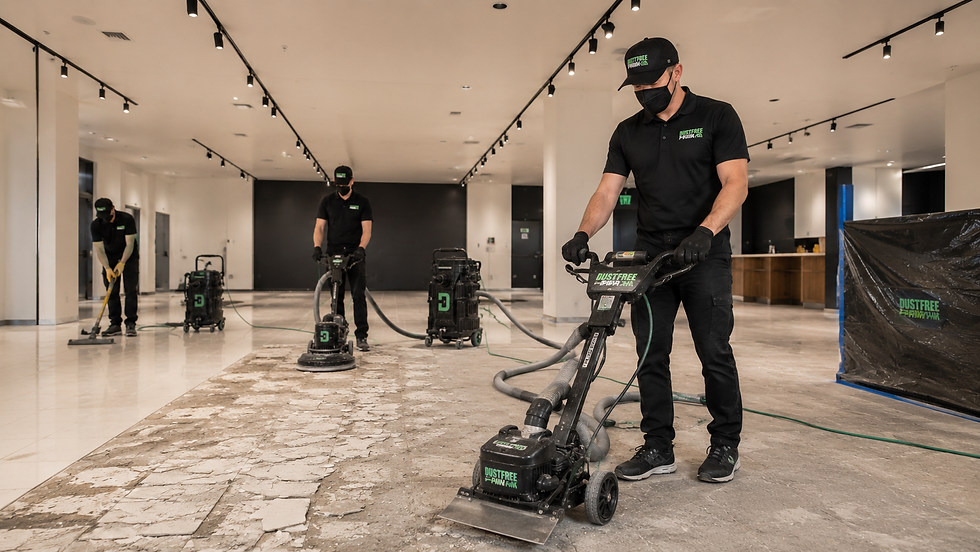
DustFree PNW provides commercial floor removal for warehouses and industrial facilities across Central Oregon. Here is what warehouse floor removal involves and why it differs from smaller-scale commercial projects.
Why Industrial Coatings Are Built to Resist Removal
Industrial floor coatings are engineered for durability standards that residential and light commercial coatings do not need to meet. Heavy-duty systems can reach abrasion loss ratings in the single digits, compared to 25 milligrams or more for lighter-duty coatings, and cure to a hardness rating that manufacturers describe as approaching bunker-concrete durability. These coatings are specifically tested against forklift traffic driven directly over the surface with blades pointed down, chemical spills, and constant rolling equipment wear, with some systems rated for a service life of ten to fifteen years under these conditions.
This same engineering that makes these coatings so effective in service is exactly what makes them demanding to remove. The chemically hardened bond formed during curing creates an adhesion to the concrete substrate that resists any form of scraping or chemical loosening once fully cured, meaning mechanical removal is the only practical approach for a coating that has been in place for any meaningful length of time.
Removal Methods for Heavy-Duty Industrial Coatings

Method | How It Works | Best For |
Diamond grinding | Diamond-tipped grinding wheels abrade the coating and any underlying primer off the concrete | Standard industrial coating removal across most warehouse applications |
Shot blasting | High-velocity steel shot strips the coating and profiles the concrete surface simultaneously | Large, expansive floor areas where speed and consistent surface profiling matter |
Combined approach | Shot blasting for bulk removal across open areas, grinding for edges, corners, and tight spaces | Most large-scale warehouse projects with irregular layouts or fixed equipment |
Shot blasting is particularly well suited to large-scale industrial applications because it accomplishes two goals in a single pass: stripping the existing coating and profiling the concrete surface to the correct texture for a new coating system to bond effectively. This dual function makes it an efficient choice for expansive warehouse floor areas where covering significant square footage quickly is a genuine priority. Diamond grinding remains the standard approach for edges, corners, and areas around fixed equipment or racking where shot blasting equipment cannot maneuver effectively.
Debris and Dust Considerations at Industrial Scale
Removing an industrial coating generates dust from both the coating material and the concrete surface beneath it, similar in principle to residential epoxy removal but at a substantially larger scale given the square footage typically involved in warehouse applications. Concrete contains crystalline silica, and the grinding or shot blasting process releases this silica as fine, respirable particulate across whatever portion of the facility is actively under removal. Source-capture equipment integrated into the grinding process, or dust collection systems paired with shot blasting equipment, are essential for keeping this large-volume dust generation controlled rather than allowing it to spread through the broader facility, particularly in warehouses where portions of the operation may remain active during a phased removal project.
Scheduling Around Logistics Operations
Warehouse and distribution operations typically cannot tolerate extended downtime without significant operational and financial consequences, given the continuous flow of inventory movement and shipping schedules these facilities depend on. This makes flexible scheduling, including off-shift work performed outside normal operating hours, phased removal that maintains partial facility operations, and rapid completion timelines, standard planning considerations for any warehouse floor removal project. A contractor experienced in industrial-scale work should be able to discuss these scheduling options directly, matching the removal approach to the facility's specific operational tolerance for disruption.
Preparing the Surface for New Industrial Flooring Systems
Whatever new flooring system follows removal, whether a new epoxy coating, a polished concrete finish, or another industrial-grade system, the quality of surface preparation during removal directly determines how well that new system will perform. A concrete surface that is inadequately profiled or still carries residual coating material will not allow a new coating to bond correctly, leading to premature peeling, delamination, or failure under the heavy use these facilities generate. Proper removal to bare, correctly profiled concrete is the foundation that any new industrial flooring investment depends on for its stated service life to actually be achieved.
What Complete Warehouse Floor Removal Delivers

A complete warehouse or industrial floor removal project delivers a concrete slab that is flat, uniformly profiled, and free of residual coating material across the full scope of the project, with all debris hauled from the facility. Dust control throughout the process should be sized appropriately to the scale of the project, and scheduling should reflect the facility's specific operational needs rather than a generic commercial timeline.
DustFree PNW handles warehouse and industrial floor removal across our Central Oregon service areas, with flexible scheduling built around logistics and operational demands. You can review our work on our Google Business Profile or get a free quote for your facility.
Final Thoughts
Warehouse and industrial floor removal operates at a scale and durability challenge that standard commercial removal equipment is not built to address. Diamond grinding and shot blasting, matched to the specific scope, combined with dust control sized for the project's volume and scheduling that respects the facility's operational demands, are what set up a warehouse floor renovation for a lasting result. Get a free quote from DustFree PNW.
FAQ
Why are warehouse floor coatings harder to remove than residential coatings?
Industrial coatings are engineered for extreme durability against forklift traffic and chemical exposure, forming a chemically hardened bond to the concrete that resists any form of scraping or chemical loosening once cured.
What is shot blasting used for in industrial floor removal?
Shot blasting uses high-velocity steel shot to strip industrial coatings while simultaneously profiling the concrete surface, making it efficient for large, expansive warehouse floor areas.
Does removing warehouse floor coatings create silica dust?
Yes. Grinding or shot blasting abrades both the coating and the underlying concrete, releasing crystalline silica dust that requires source-capture equipment or dust collection systems to control at industrial scale.
Can warehouse floor removal happen without shutting down operations?
Often, yes. Off-shift scheduling and phased removal that maintains partial facility operations are standard approaches for warehouses that cannot tolerate extended downtime.
Why does surface profiling matter for new industrial flooring?
A properly profiled, coating-free concrete surface allows new industrial coatings to bond correctly. Inadequate removal leads to premature peeling or delamination under heavy warehouse use.
Does DustFree PNW handle warehouse and industrial floor removal in Central Oregon?
Yes. DustFree PNW provides large-scale industrial floor removal with flexible scheduling across Central Oregon. Contact us for a free quote.


Comments