
Commercial Floor Removal: What's Involved
TL;DR: Commercial floor removal follows a structured process: site evaluation, dust containment setup, material removal using equipment matched to the flooring type, and slab preparation for the next flooring system. Commercial projects differ from residential ones in scale, adhesive complexity, and the need to minimize business downtime, which makes equipment selection and scheduling especially important for Central Oregon businesses.

Key Takeaways
Commercial floor removal begins with a site evaluation that determines flooring type, adhesive condition, and subfloor status, all of which shape the removal method and timeline.
Commercial spaces frequently involve larger square footage, heavier-duty adhesives, and more complex subfloor conditions than residential projects, requiring commercial-grade equipment rather than residential tools scaled up.
Minimizing business downtime is a primary scheduling concern for commercial floor removal, often addressed through night, weekend, or phased scheduling around business hours.
Dust containment is especially critical in sensitive commercial environments such as healthcare, food service, and occupied retail spaces where airborne dust affects operations beyond the immediate work zone.
A complete commercial floor removal includes surface material removal, adhesive or coating removal, subfloor leveling, and debris haul-away, not just the visible flooring layer.
Commercial floor removal covers a wide range of business environments across Central Oregon, from office renovations to restaurant remodels to retail store updates. What these projects share is a set of demands that differ meaningfully from residential flooring removal: larger scale, more complex adhesive systems, and a business that often needs to remain at least partially operational during the work.
DustFree PNW provides commercial floor removal across Central Oregon for offices, retail spaces, restaurants, and other business environments. Here is what the full process involves from the initial site evaluation to a finished, installation-ready slab.
Step One: Site Evaluation
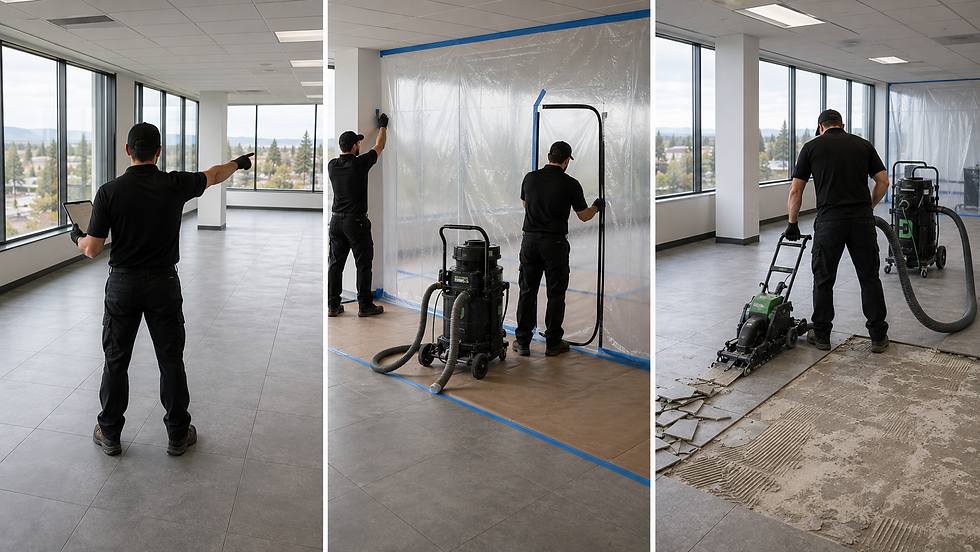
Every commercial floor removal project begins with a site evaluation that determines the current flooring type, how it was installed, and the condition of the subfloor beneath it. This assessment shapes every decision that follows: what equipment will be needed, how much labor the job will require, and what the realistic timeline looks like given the space's specific conditions.
This step also identifies material-specific considerations. Commercial-grade carpet is frequently glued down rather than tacked, which changes the removal approach. Vinyl composition tile and sheet vinyl often leave adhesive residue that requires additional cleanup. Epoxy and concrete coatings require grinding rather than lifting. Getting this evaluation right before work begins prevents the project from encountering surprises partway through.
The Commercial Floor Removal Process Step by Step
Phase | What Happens | Why It Matters in Commercial Settings |
1. Site evaluation | Assess flooring type, adhesive, subfloor condition, and square footage | Determines equipment, labor, and realistic timeline before work begins |
2. Area prep and containment | Clear furniture and equipment, set up dust barriers and ventilation | Especially critical in healthcare, food service, and occupied retail spaces |
3. Material removal | Mechanical scrapers, grinders, or chipping tools matched to the flooring type | Commercial-grade adhesives and heavier materials require commercial-grade tools |
4. Adhesive and coating removal | Grinding to remove mastic, thinset, or epoxy coatings down to bare slab | Incomplete adhesive removal causes new flooring to bond poorly |
5. Subfloor prep and leveling | Grinding high spots, addressing cracks, confirming flatness | Commercial installations often require tighter flatness tolerances |
6. Debris haul-away | Removing all material from the property | Commercial volume debris requires appropriately sized transport |
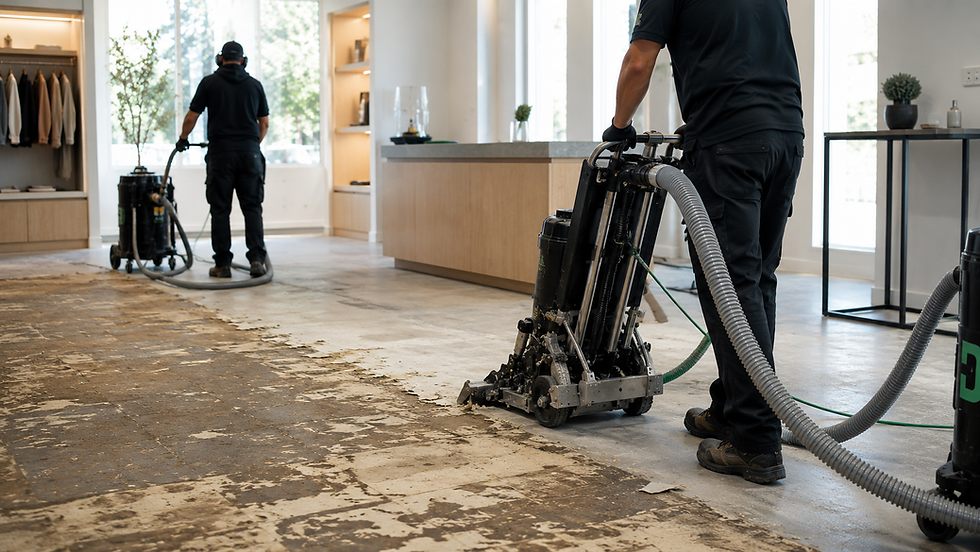
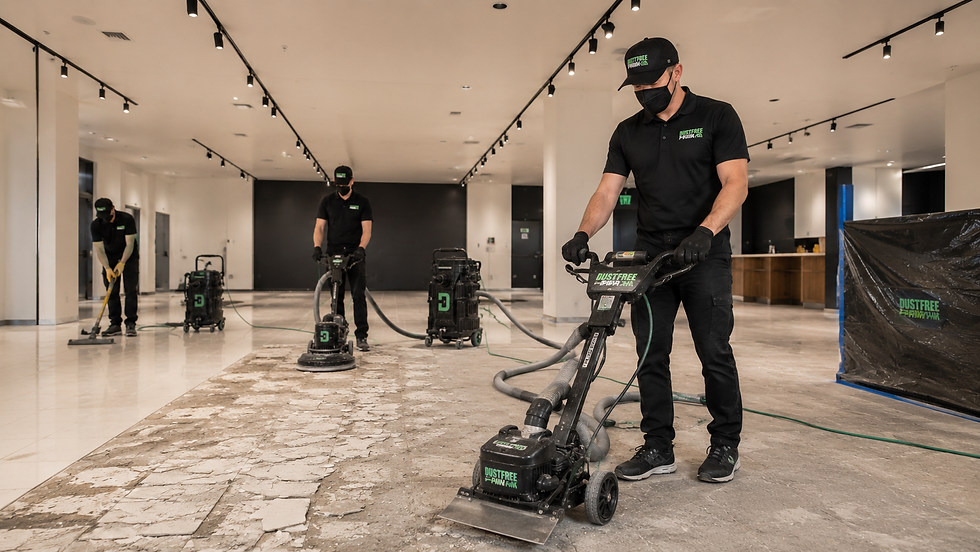
The dust containment phase deserves particular attention in commercial settings. Sensitive environments such as medical and dental offices, restaurants, and occupied retail spaces have specific reasons to control dust beyond general cleanliness: airborne particulate can affect food safety, medical equipment, and merchandise in ways that go beyond a typical residential concern. Source-capture equipment integrated at the tool head, rather than relying solely on containment barriers, is the more reliable approach in these environments.
Why Commercial Projects Differ From Residential Removal
Commercial floor removal differs from residential work in several consistent ways. Square footage is typically larger, which changes equipment selection toward higher-capacity tools designed for volume rather than single-room precision. Commercial-grade adhesives, particularly under VCT and commercial carpet, are often applied more heavily than residential equivalents, adding time to the adhesive removal phase. Subfloor conditions in older commercial buildings can include multiple layers of prior flooring installations, each requiring identification and removal.
Perhaps most distinctly, commercial projects almost always carry a downtime consideration that residential projects do not. A business needing to remain open, or return to operation quickly, shapes the entire project schedule around minimizing disruption rather than simply completing the work as fast as possible.
Scheduling Around Business Operations
Minimizing downtime is frequently the central planning concern for commercial floor removal. This is commonly addressed through scheduling work during nights, weekends, or off-peak hours, or through phased removal that clears one section of a space at a time while adjacent areas remain in use. For businesses that cannot close entirely during a renovation, discussing scheduling flexibility with the demo contractor before the project begins is one of the most valuable planning conversations available.
Materials Commonly Removed in Commercial Projects
Commercial floor removal covers a wide range of material types depending on the business environment. Commercial carpet, both glued and tacked varieties, is common in offices and requires different approaches for each installation type. Vinyl composition tile and sheet vinyl appear frequently in retail and healthcare settings and typically leave mastic residue requiring grinding. Ceramic, porcelain, and natural stone tile show up in restaurants, lobbies, and high-end retail spaces. Epoxy and concrete coatings, common in warehouses and industrial spaces, require grinding rather than lifting since they are bonded directly to the slab.
What a Complete Commercial Floor Removal Delivers
A complete commercial floor removal project delivers a slab that is flat, clean, and free of adhesive or coating residue, with all debris hauled from the property. The subfloor should meet the flatness tolerance required by whatever new flooring or coating system is planned next, and any subfloor damage or condition issues should be identified and communicated before the crew leaves the site.

DustFree PNW provides commercial floor removal across our Central Oregon service areas, working with offices, retail spaces, restaurants, and other businesses on flexible scheduling to minimize downtime. You can review our work on our Google Business Profile or get a free quote for your commercial project.
Final Thoughts
Commercial floor removal follows a structured process built around the specific demands of business environments: larger scale, more complex adhesive systems, and a real need to minimize operational disruption. Understanding each phase, from site evaluation through debris haul-away, helps business owners plan realistically and choose a contractor equipped for the scale and complexity of the project. Get a free quote from DustFree PNW.
FAQ
What is involved in commercial floor removal?
Commercial floor removal involves site evaluation, dust containment setup, material removal matched to the flooring type, adhesive or coating removal, subfloor leveling, and debris haul-away.
How is commercial floor removal different from residential removal?
Commercial projects typically involve larger square footage, heavier-duty adhesives, more complex subfloor conditions, and a need to minimize business downtime that residential projects do not carry.
Can a business stay open during commercial floor removal?
Often, yes, through scheduling work during off-peak hours or phasing the removal to clear one section while adjacent areas remain in use. Discuss scheduling flexibility with the contractor before the project begins.
Why does dust control matter more in some commercial settings?
Environments like healthcare facilities, restaurants, and occupied retail spaces have specific sensitivities to airborne dust beyond general cleanliness, including food safety and equipment protection concerns.
What materials are commonly removed in commercial floor removal?
Commercial carpet, vinyl composition tile, sheet vinyl, ceramic and porcelain tile, natural stone, and epoxy or concrete coatings are all common in commercial floor removal projects.
Does DustFree PNW provide commercial floor removal in Central Oregon?
Yes. DustFree PNW provides commercial floor removal for offices, retail, restaurants, and other businesses across Central Oregon with flexible scheduling to minimize downtime. Contact us for a free quote.

Comments