
Thinset Removal Company: What to Look For Before Hiring
TL;DR: A qualified thinset removal company uses grinding equipment with integrated dust capture, provides a written scope that includes full slab preparation rather than just surface scraping, and holds an active CCB license. Thinset removal is often the messiest and most technically demanding phase of a flooring project when done incorrectly, which makes the equipment and process a company uses more important than the price quoted.

Key Takeaways
Thinset removal is frequently the messiest and most technically demanding phase of a flooring project, more so than removing the tile itself, because grinding cement-based mortar generates significant crystalline silica dust.
Thin, lightly applied thinset can sometimes be manually scraped, but thick or tightly bonded thinset requires grinding equipment with an integrated vacuum shroud to avoid filling the home with dust.
A qualified thinset removal company grinds the slab down to bare, level concrete rather than leaving a scraped surface with remaining high spots, which reduces the floor leveling work required before installation.
Any company performing construction work in Oregon must hold an active CCB license, which is publicly verifiable before booking.
A complete thinset removal scope leaves the slab flat, clean, and free of mortar residue, with debris hauled from the property the same day.
Thinset is the cement-based mortar that bonds tile to a concrete subfloor, and it is one of the most consistently underestimated parts of a flooring removal project.
Homeowners often plan for the tile itself to be the difficult part, only to discover that the mortar layer left behind on the slab is the phase that determines whether the project stays on schedule. Choosing the right thinset removal company matters because the difference between a properly ground slab and a scraped, uneven one shows up directly in how well the new flooring installs and performs.
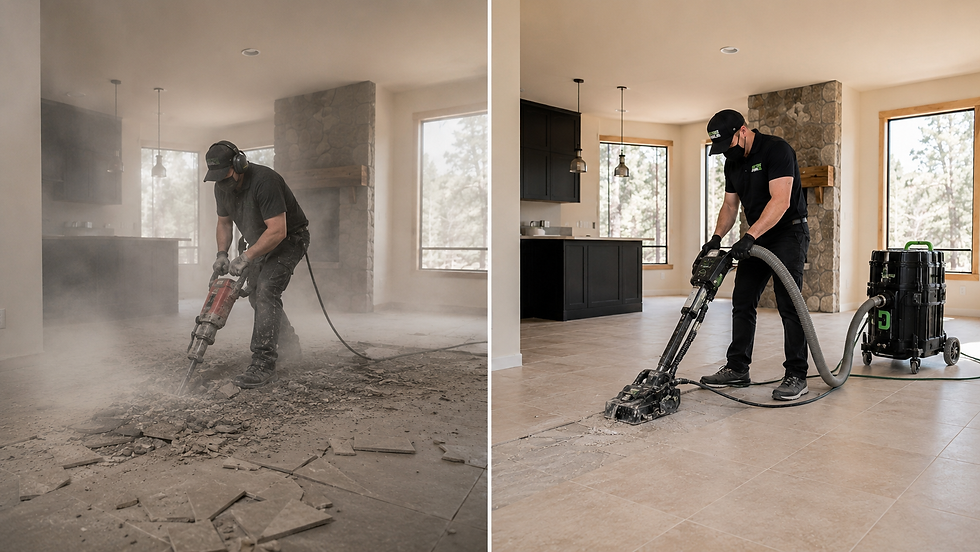
DustFree PNW provides dedicated thinset removal across Central Oregon, using source-capture grinding equipment built for this specific phase of a flooring project. Here is what separates a qualified thinset removal company from a general crew and what to confirm before hiring one.
Why Thinset Removal Is Often the Hardest Part of a Flooring Project
Thinset is a blend of cement, fine sand, and additives that allow the cement to hydrate properly once applied. It is designed to bond tile permanently to a subfloor, which is exactly what makes it difficult to remove once that tile comes up. Unlike the tile itself, which can often be chipped and lifted in sections, the thinset layer remains bonded across the entire slab surface and has to be addressed as a continuous grinding job rather than a series of individual pieces.
This is also the phase where dust generation is highest. Grinding cement-based mortar releases crystalline silica dust continuously as the diamond wheel contacts the slab, and unlike tile chipping, this process does not pause between pieces. A thinset removal job without proper dust capture can fill a home with fine silica particulate faster than the tile removal phase that preceded it.
What Separates a Qualified Thinset Removal Company

Factor | Qualified Thinset Removal Company | General Crew or Handyman |
Equipment | Diamond grinding wheel with integrated vacuum shroud | Manual scraper or grinder with no dust capture |
Result on slab | Ground to bare, level concrete; high spots removed | Scraped surface with remaining unevenness |
Dust management | Source-capture at the tool head, HEPA filtration | Shop vacuum nearby, if any dust control at all |
Scope completeness | Full slab grinding, debris haul-away included | Partial scraping; leveling issues left for installer |
Licensing | Active CCB license, verifiable | May not carry a license; always verify independently |
The difference between grinding and scraping matters more than it might first appear. Scraping removes the top layer of thinset but frequently leaves a surface with variable thickness and remaining high spots, since manual scraping cannot achieve the consistent, level result that mechanical grinding produces. A company that grinds the slab down to bare, uniform concrete reduces or eliminates the floor leveling work the installation crew would otherwise need to perform, saving time and cost at the next phase of the project.
Manual Scraping vs Grinding: When Each Applies
Not every thinset removal job requires grinding. If the mortar layer was thinly applied and has not bonded tightly to the slab, a manual floor scraper or chisel may be sufficient, particularly for smaller areas where the time investment of manual work is reasonable. This approach generates less dust and requires less specialized equipment.
For thicker thinset applications, or mortar that has bonded tightly to the concrete over years, grinding with a diamond cup wheel becomes the only practical method. This is also where the equipment specification becomes critical: grinding without an integrated vacuum shroud and HEPA filtration generates substantial airborne silica dust, since the grinding motion is continuous across the entire slab rather than the intermittent impact of chipping tile. Any company using a grinder should be using one connected to an industrial HEPA vacuum system, not a standard shop vacuum.
Questions to Ask Before Hiring a Thinset Removal Company
A handful of direct questions separate a company that will deliver a properly prepared slab from one that will leave problems for the installation crew to discover. Ask what equipment is used for grinding and whether the vacuum is integrated into the tool or runs separately nearby. Ask whether the goal is a level, ground slab or simply removing visible thinset chunks. Ask whether debris haul-away is included in the quoted scope.
And confirm the company holds an active CCB license, which is publicly verifiable through the Oregon Construction Contractors Board before any work begins.
A company that answers these specifically, without hedging, is generally the more reliable choice. One that is vague about equipment or scope is worth investigating further before booking.
Why the Slab Condition After Thinset Removal Matters
Leaving old thinset residue or an uneven slab creates real problems for the new flooring installation. Uneven surfaces can cause holes, cracks, and instability in the new floor, and these issues are often not fully visible until the new material is installed and begins to show wear. A slab that has been properly ground to bare, level concrete allows the installation crew to identify any remaining high or low spots accurately and address them with minimal additional leveling work, rather than fighting through inconsistent mortar residue.
What a Complete Thinset Removal Job Delivers
A complete thinset removal leaves the concrete slab flat, uniformly clean of mortar residue, and free of dust contamination on adjacent surfaces or in the home's HVAC system. All debris generated during grinding, which can be substantial given the density of cement-based mortar, should be hauled from the property as part of the completed scope, not left for the homeowner to arrange separately.

DustFree PNW provides thinset removal across our Central Oregon service areas, including Bend, Redmond, Sisters, Tumalo, and Madras. You can review our work on our Google Business Profile or get a free quote for your thinset removal project.
Final Thoughts
Thinset removal is a phase where equipment and process matter more than most homeowners expect going into a flooring project. A qualified thinset removal company grinds the slab to a level, clean surface rather than leaving scraped residue behind, and does so with dust control that protects the home throughout the job. Verifying licensing, equipment, and scope before booking is what separates a smooth project from one that adds unexpected delays. Get a free quote from DustFree PNW.
FAQ
What should I look for in a thinset removal company?
Grinding equipment with an integrated vacuum shroud, a scope that includes full slab leveling rather than surface scraping, debris haul-away, and an active, verifiable CCB license.
Is thinset removal harder than tile removal?
It is often more demanding in terms of dust generation, since grinding cement-based mortar is a continuous process across the entire slab rather than the intermittent impact of chipping individual tiles.
Can thinset be removed without grinding?
Thin, lightly bonded thinset can sometimes be manually scraped, particularly in small areas. Thicker or tightly bonded thinset typically requires grinding equipment for a clean, level result.
Does a thinset removal company in Oregon need a CCB license?
Yes. All contractors performing construction work in Oregon must hold a valid CCB license, verifiable through the Oregon CCB database before booking any thinset removal company.
What happens if thinset is not fully removed before new flooring installation?
Uneven or incomplete thinset removal can cause holes, cracks, and instability in the new floor, issues that often are not fully visible until the new material is installed and begins to show wear.
Does DustFree PNW provide thinset removal in Central Oregon?
Yes. DustFree PNW grinds thinset to a flat, clean slab using source-capture equipment across Bend, Redmond, Sisters, Tumalo, Madras, and surrounding Central Oregon communities. Contact us for a free quote.


Comments