
School and Office Renovation: Demo Scheduling That Works
TL;DR: School office renovation demo scheduling is essential for keeping flooring projects on track around strict occupancy deadlines. Schools often schedule classroom, hallway, and restroom flooring removal during summer break, when every phase must be carefully coordinated before students return. Office projects typically allow more flexibility, but phased, floor-by-floor, or off-hours demolition can help businesses remain operational. In both environments, effective scheduling and dust-control methods reduce disruption while keeping the renovation timeline moving efficiently.

Key Takeaways
School flooring projects are frequently scheduled within the summer break window, since these projects need to be sequenced with essentially no room for delay given the hard first-day-of-school reopening deadline.
Not all school renovation work waits for summer. Safety improvements and urgent system upgrades sometimes need to happen during the academic year, requiring careful scheduling around class hours and events.
Office renovations have more scheduling flexibility than schools, but many still benefit from floor-by-floor or zone-by-zone phasing to keep the majority of the business operational throughout the project.
Noise control expectations vary by building type: office renovations generally need to avoid disrupting business hours, while multi-use facilities may have different noise-sensitive periods depending on their specific occupancy patterns.
Clear communication with administrators, staff, or building occupants throughout the project, not just at the outset, is consistently cited as one of the most important factors in a smooth occupied-building renovation.
Flooring demo in a school or office setting carries scheduling stakes that a typical residential project simply does not have. A school district cannot delay the first day of classes because a flooring project ran long, and an office renovation that drags on unexpectedly disrupts business operations in ways that compound with every additional day. Understanding how these scheduling pressures actually get managed helps property managers, school facilities staff, and business owners plan realistically.
DustFree PNW provides commercial floor removal for schools and offices across Central Oregon, with scheduling approaches matched to each facility's specific constraints. Here is how demo scheduling actually works in these two settings.
Summer Windows vs Occupied-Building Phasing

Setting | Typical Scheduling Approach | Key Constraint |
K-12 classroom renovation | Summer break window with no float for delays | Hard reopening date at the start of the school year |
Urgent school system upgrades | Academic-year work scheduled around class hours and events | Must avoid disrupting instruction and student safety |
Office renovation, single tenant | Off-hours or weekend work, sometimes full closure for larger scopes | Minimizing disruption to business hours |
Multi-tenant office building | Floor-by-floor phasing to isolate noise and dust from occupied floors | Vertical separation between construction and occupied areas |
School flooring renovations are most commonly scheduled within the summer break, since classroom reconfigurations, corridor upgrades, restroom renovations, and similar projects need to be sequenced within that fixed window with essentially no room for delay. Missing the reopening deadline is simply not an option for a school district, which places genuine pressure on accurate timeline estimates and reliable subcontractor performance for any demo work included in a summer renovation scope.
When School Renovation Cannot Wait for Summer
Not every school renovation project can wait for the summer window. Safety improvements, urgent system upgrades, and certain code-driven renovations sometimes need to proceed during the academic year, which requires considerably more careful coordination than a summer project. This typically means scheduling the loudest, most disruptive phases of demo work for after school hours, weekends, or specific windows coordinated with the school's daily schedule, and maintaining clear separation between construction zones and occupied classroom areas throughout the project.
Office Renovation: More Flexibility, Still Real Constraints
Office renovations generally offer more scheduling flexibility than school projects, since there is no equivalent to a fixed academic calendar forcing a hard summer-only window. That said, occupied office renovations still carry genuine constraints: noise during business hours can disrupt calls, meetings, and concentrated work, and dust migrating into occupied areas raises both comfort and, depending on the scope, potential health considerations for employees without construction-grade protective equipment.
For multi-story or multi-tenant office buildings specifically, floor-by-floor phasing offers a genuine advantage: vertical separation between the active work zone and occupied floors provides better noise and dust isolation than trying to manage a renovation happening on the same floor as ongoing business operations. This phased approach allows an office renovation to proceed without requiring a full building closure, similar in principle to phased retail renovation approaches.
Why Communication Matters as Much as Scheduling
Across both school and office renovation contexts, clear, ongoing communication with administrators, staff, or building occupants is consistently identified as one of the most important factors in a smooth project, arguably as important as the scheduling plan itself. Providing regular updates, posting class or work schedules where relevant, and addressing concerns promptly throughout the project, rather than only at the outset, helps building occupants adjust to the disruption and reduces the friction that comes from feeling caught off guard by unexpected noise or activity.
Dust Control's Specific Value in These Settings
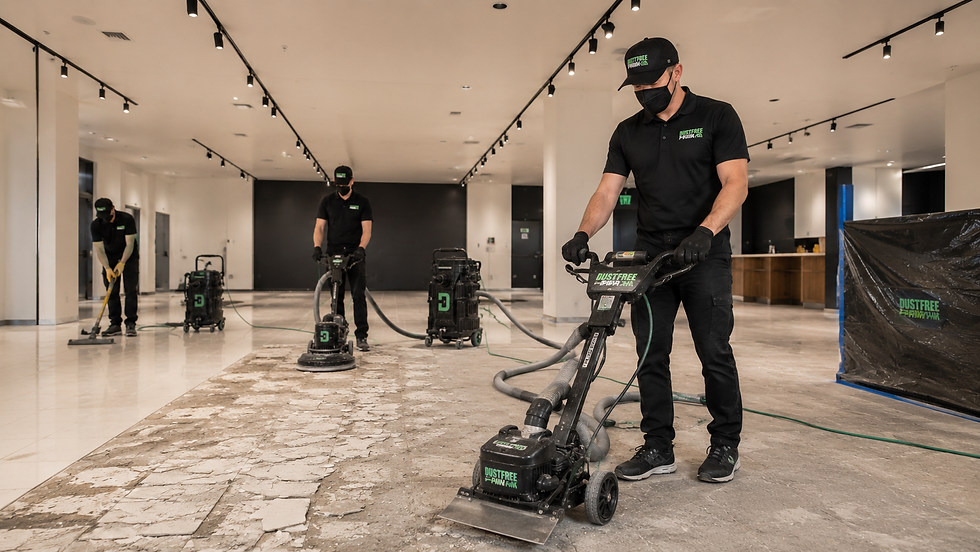
Renovation dust and airborne contaminants represent a genuinely pervasive concern in occupied educational and office buildings, since construction activity generates particles that can affect air quality throughout a building, not just within the immediate work area. Unlike a typical construction site where workers expect and are equipped for dust exposure, school staff, students, and office employees generally are not equipped with protective gear and should not need to be. Source-capture dust control equipment, which prevents dust from becoming airborne at the point of creation, directly addresses this gap between construction-standard exposure and the expectations of a normal occupied building.
What On-Schedule Completion Delivers

A well-scheduled school or office flooring demo project delivers a completed, clean subfloor ready for new flooring installation within the timeframe the project's hard deadline or business operations required, with dust and noise contained to the active work zone throughout and clear communication maintained with building occupants at every stage.
DustFree PNW works with schools and businesses across our Central Oregon service areas to schedule flooring demo around each facility's specific constraints. You can review our work on our Google Business Profile or get a free quote for your project.
Final Thoughts
School and office flooring renovations both demand careful scheduling around occupancy, whether that means a fixed summer window with a hard reopening deadline or phased, off-hours work to keep a business operational. Strategic scheduling, dust control appropriate to an occupied building, and consistent communication throughout the project are what keep these renovations on track. Get a free quote from DustFree PNW.
FAQ
School Office Renovation Demo Scheduling: When Is It Best?
Most commonly during the summer break window, since projects need to be sequenced with no room for delay given the hard reopening deadline at the start of the school year.
Can school renovation happen during the school year?
Yes, for urgent safety improvements or system upgrades, though this requires careful scheduling around class hours and events to avoid disrupting instruction.
How is office renovation scheduled differently from schools?
Offices have more flexibility without a fixed academic calendar, but still often use off-hours work or floor-by-floor phasing to minimize disruption to business operations.
Why does floor-by-floor phasing help in multi-tenant office buildings?
Vertical separation between construction and occupied floors provides better noise and dust isolation than managing a renovation on the same floor as active business operations.
Why does dust control matter more in schools and offices than typical job sites?
Students, staff, and employees are not equipped with construction-grade protective gear, making source-capture dust control important for keeping air quality safe throughout the building.
Does DustFree PNW schedule flooring demo around school and office operations in Central Oregon?
Yes. DustFree PNW works with schools and businesses to schedule flooring demo around each facility's specific constraints across Central Oregon. Contact us for a free quote.


Comments