
Retail Store Floor Removal During Renovation
TL;DR: Retail store floor removal increasingly happens while the store remains open to customers, using overnight scheduling, phased zone-by-zone work, and containment barriers with negative air pressure to keep construction activity separated from shoppers. This open-store approach protects revenue that a full closure would sacrifice, but it requires more careful coordination, staging, and dust control than a straightforward closed-store demolition project.

Key Takeaways
Retail renovations increasingly happen while stores remain open, since even short closures can create significant revenue losses that many retailers are no longer willing to absorb.
Open-store floor removal typically relies on overnight scheduling, phased zone-by-zone work, or a combination of both, with all materials and subcontractors staged and ready before each work shift begins.
Containment barriers maintained at negative pressure relative to occupied retail space, paired with HEPA-filtered air scrubbers, are the standard approach for keeping dust separated from customer areas during active-hours work.
Moving merchandise, fixtures, and inventory out of the work zone before removal begins requires careful coordination with store staff, and temporary staging areas need to be identified before the project starts.
Closed-store renovations, where the location shuts down entirely, generally execute faster than phased open-store work, but sacrifice all revenue during the closure, making the right choice dependent on the retailer's specific financial tolerance for disruption.
Retail store floor removal in Central Oregon increasingly happens under a very different model than the traditional close-the-store-and-renovate approach. With physical retail locations still generating the majority of total retail sales for most businesses, even a short full closure can translate into meaningful, measurable revenue loss. As a result, many retailers now choose to renovate their flooring while remaining open to customers, which introduces coordination challenges that a straightforward closed-store demolition project does not have to address.
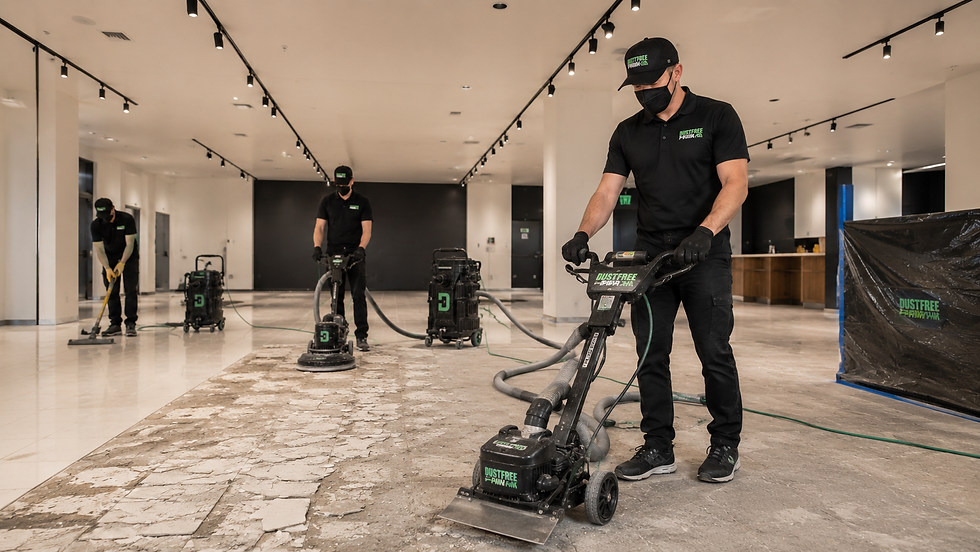
DustFree PNW provides commercial floor removal for retail spaces across Central Oregon, with scheduling approaches built around minimizing disruption to ongoing business operations. Here is how open-store floor removal actually works and what it takes to execute successfully.
Why Retailers Are Moving Away From Full Closures
The straightforward model of closing a store entirely for the duration of a renovation was once the default approach, but this model has become increasingly impractical for many retailers facing constant pressure to refresh store environments, roll out updated concepts across multiple locations, and upgrade building systems without sacrificing revenue for extended periods. Even a short closure creates significant operational disruption and lost sales, and for retailers operating across multiple locations, closing even one store for a floor renovation compounds this impact across a broader business footprint.
This shift means construction and floor removal activity increasingly occurs within an active retail environment where customers, employees, deliveries, and ongoing merchandising operations continue throughout the project. From a construction management perspective, this changes the primary difficulty of the project from the technical scope of the removal itself to the coordination required to execute that scope safely within a space that remains functionally open for business.
Open Store vs Closed Store: Choosing an Approach

Approach | How It Works | Best For |
Overnight scheduling | Floor removal happens during closed hours; store reopens each morning with the work zone contained or completed | Smaller-scope projects that can be completed within available overnight windows |
Phased zone-by-zone work | Work proceeds section by section, moving fixtures and inventory ahead of each phase | Larger projects where the full floor cannot be completed overnight |
Rolling weekend approach | Work happens Monday through Thursday with full access restored Friday through Sunday | Retailers whose peak revenue periods fall on weekends |
Full closure | Store closes entirely for the duration of the project | Deep renovations involving extensive demolition or structural work where speed outweighs the cost of lost revenue |
Open-store approaches require significantly more upfront preparation than a closed-store project. Materials, prefabricated assemblies, and subcontractors all need to be ready and staged before each work shift begins, since opportunities to recover lost schedule time within a limited overnight or after-hours window are genuinely limited. Missing this preparation window on any given night can push an entire phase of the project behind schedule in a way that a closed-store project, with continuous daytime access, would not experience in the same way.
Containment and Dust Control in an Occupied Retail Space
Keeping construction dust separated from customer-facing areas during open-store floor removal relies on containment barriers, typically sealed poly barriers maintained at negative pressure relative to the occupied retail space, paired with HEPA-filtered negative air machines and industrial air scrubbers. HVAC return vents in the affected area are frequently sealed temporarily as well, preventing dust from entering the building's broader air circulation system and reaching parts of the store far from the immediate work zone.
Source-capture equipment integrated at the demolition tool itself adds another meaningful layer of protection in this context, since it reduces the volume of dust the containment and air scrubbing systems need to manage in the first place. For a retail environment where customers are shopping in close proximity to an active work zone separated only by a temporary barrier, minimizing dust generation at the source is a genuinely valuable complement to the containment strategy rather than a redundant precaution.
Coordinating Merchandise and Fixture Staging
Moving merchandise, display fixtures, and inventory out of the active work zone before removal begins requires careful coordination between the demolition crew and store staff. Heavy fixtures, including gondola shelving, display cases, and checkout counters, often require professional movers or furniture dollies rather than simple hand-carrying. Identifying temporary staging areas before the project starts, whether a stockroom, an adjacent vacant space, or off-site storage, prevents merchandise from interfering with the removal work or being damaged by dust and debris during the process.
What Complete Retail Floor Removal Delivers

A complete retail store floor removal project clears old flooring and adhesive residue down to a flat, clean subfloor, protects merchandise and fixtures throughout the process, and delivers each phase on the schedule the retailer's operational planning depended on. Containment and dust control should keep customer-facing areas fully separated from the work zone throughout, whether the project runs overnight, in phases, or on a rolling weekend schedule.
DustFree PNW works with retail businesses across our Central Oregon service areas, with scheduling flexibility around overnight and phased approaches to keep stores operational during renovation. You can review our work on our Google Business Profile or get a free quote for your retail project.
Final Thoughts
Retail store floor removal increasingly happens without a full closure, relying on overnight scheduling, phased zone work, and containment with negative air pressure to keep customers shopping while renovation proceeds behind the scenes. Choosing the right scheduling approach for your specific store, budget, and revenue tolerance is the decision that determines whether the project protects both the timeline and the bottom line. Get a free quote from DustFree PNW.
FAQ
Can Retail Store Floor Removal Renovation Be Completed While the Store Stays Open?
Yes. Overnight scheduling, phased zone-by-zone work, and containment barriers with negative air pressure allow floor removal to happen while the store remains open to customers during business hours.
What is used to contain dust during an open-store floor removal?
Sealed poly barriers maintained at negative pressure, HEPA-filtered air scrubbers, and temporarily sealed HVAC return vents are the standard containment approach in an occupied retail environment.
Is overnight or phased scheduling better for retail floor removal?
It depends on project size. Overnight scheduling suits smaller-scope projects completable within available hours, while phased zone-by-zone work suits larger projects that cannot be finished overnight.
Why would a retailer choose a full store closure instead?
Full closures generally execute faster than phased open-store work and are typically better suited to deep renovations involving extensive demolition, though they sacrifice all revenue during the closure period.
How is merchandise protected during retail floor removal?
Fixtures and inventory are moved to identified staging areas, such as a stockroom or off-site storage, before removal begins, preventing damage from dust or interference with the work.
Does DustFree PNW handle retail floor removal in Central Oregon?
Yes. DustFree PNW provides retail floor removal with overnight and phased scheduling options across Central Oregon. Contact us for a free quote.


Comments