
Is Dust-Free Demo Worth It Compared to Traditional Demo?
TL;DR: Yes, for most residential and commercial demo projects, the value extends well beyond simply avoiding a mess. Dust-free demo protects health by controlling silica exposure, preserves the ability to stay home or keep a business partially operational during the project, prevents accidental damage to plumbing and finishes caused by poor visibility in dusty conditions, and eliminates the extended cleanup time that traditional demo leaves behind. The real comparison is not "clean versus messy" but rather the total time, risk, and disruption each approach adds to a project.

Key Takeaways
Traditional demolition's hidden costs come largely from time, not the demolition itself: containment setup and post-project cleanup can add multiple days of intensive work that dust-free methods largely eliminate.
Fine silica dust from traditional demo, measuring less than 10 microns, can remain airborne for hours or even days, infiltrating a home well beyond the immediate work area regardless of plastic sheeting containment.
Reduced visibility from dust clouds during traditional demo increases the risk of accidental damage to plumbing, electrical systems, and adjacent finishes that a dust-free approach with clear sightlines avoids.
Dust-free demo allows many households to remain in their homes during a project, avoiding the disruption and logistics of temporary relocation that traditional demo sometimes necessitates.
The transition from demo to the next phase of a project happens faster with dust-free methods, since there is no extensive cleanup step required before installation or finish work can begin.
Whether dust-free demo is worth it compared to traditional demolition is really a question about where the value actually shows up across a project, not simply whether one method looks cleaner during the work itself. When the comparison accounts for cleanup time, health protection, damage prevention, and how quickly a project can move to its next phase, the value case for dust-free demo becomes considerably clearer than a surface-level comparison suggests.
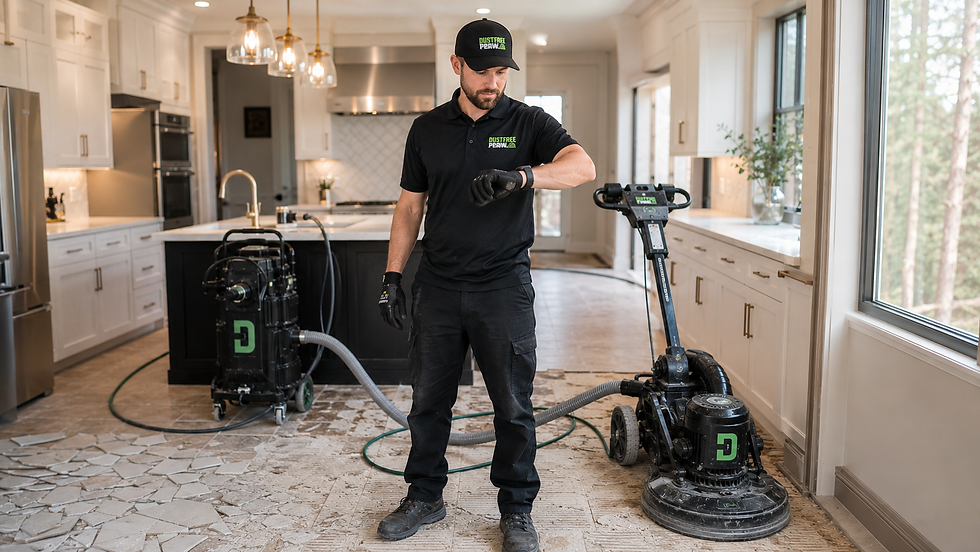
DustFree PNW's interior demolition service is built around this full value proposition, not just visible cleanliness, across Central Oregon. Here is where the real difference shows up.
Where the Real Value Difference Shows Up

Factor | Traditional Demo | Dust-Free Demo |
Cleanup time after work | Can require multiple days of intensive cleaning across affected surfaces | Minimal; largely eliminated by source-capture equipment |
Health exposure | Fine silica dust can remain airborne for hours or days, spreading through the home | Captured at the source before entering the air |
Visibility during work | Dust clouds reduce visibility, increasing risk of accidental damage to plumbing or wiring | Clear sightlines throughout the work, reducing incidental damage risk |
Ability to stay home or keep business open | Often requires relocation or full closure due to dust spread | Frequently allows staying home or partial business operation |
Time to next project phase | Delayed by extensive cleanup before installation can begin | Faster transition since minimal cleanup is needed |
The time requirements for traditional demolition create costs that many homeowners do not fully anticipate going into a project. While the actual breaking apart of materials may proceed relatively quickly, the preparation and cleanup phases can extend the overall project timeline significantly, with post-demolition cleanup alone sometimes requiring multiple days of intensive work to remove dust from every affected surface.
Why Containment Alone Does Not Solve the Health Question
Traditional demolition typically relies on plastic sheeting and general containment measures, but these prove inadequate for capturing the finest particles that pose the greatest health risk. Silica dust measuring less than 10 microns in diameter is small enough to remain airborne for hours or even days after the visible demolition work is complete, infiltrating areas well beyond the immediate work zone regardless of how carefully containment barriers were set up. This is the core reason dust-free, source-capture equipment represents a fundamentally different approach rather than simply an incremental improvement on traditional containment methods.
The Visibility and Damage Prevention Factor
A less discussed but genuinely significant value factor is visibility. As traditional demolition progresses, dust clouds become increasingly dense, reducing the visibility workers have of the space they are working in. This lack of clear sightlines increases the likelihood of accidental damage to plumbing, electrical systems, or adjacent flooring and finishes, since crews working in dusty, low-visibility conditions cannot see clearly enough to work with full precision. Dust-free demo, by keeping the work area visibly clear throughout the process, allows for more precise, careful work that reduces this incidental damage risk.
The Relocation Question
One of the most tangible value differences is whether a household or business needs to temporarily relocate or close during the project. Dust-free demo, by keeping silica dust and fine particulate largely out of the home's air, allows many families to remain in their homes throughout a project, avoiding the logistics, cost, and disruption of finding alternate accommodations. For commercial spaces, this same principle allows many businesses to remain at least partially operational during floor removal or interior demo, rather than absorbing the full impact of a complete closure.
Faster Transition to the Next Project Phase
Perhaps the most consistently underestimated value factor is how much faster a project can move from demo into its next phase when dust-free methods are used. Traditional demolition leaves behind layers of lingering dust on floors, walls, tools, and often deep within HVAC ductwork, all of which needs to be addressed before installation or finish work can reasonably begin. Dust-free approaches, by containing debris at the source, eliminate most of this cleanup burden, allowing the project to move directly into its next phase without the delay that extensive post-demo cleaning otherwise requires.
What the Value Looks Like in Practice

In practice, the value of dust-free demo shows up as a project that moves faster overall despite the demolition phase itself taking similar or only slightly longer than traditional methods, a home or business that remains more usable throughout the process, and a household that avoids the health exposure and accidental damage risks that traditional methods carry. When these factors are weighed together, dust-free demo represents a meaningfully different value proposition than a simple cleanliness comparison suggests.
DustFree PNW provides dust-free demolition across our Central Oregon service areas, delivering this full value proposition on every project. You can review our work on our Google Business Profile or get a free quote for your project.
Final Thoughts
Dust-free demo is worth it when the comparison accounts for the full picture: health protection, cleanup time, accidental damage risk, and how quickly a project can transition to its next phase, not just how clean the work area looks during demolition itself. For most Central Oregon homeowners and businesses, these combined factors make dust-free demo the more practical choice for nearly any interior demo project. Get a free quote from DustFree PNW.
FAQ
Is Dust-Free Demo Worth It Compared to Traditional Demolition?
Yes, for most projects, when the comparison accounts for health protection, cleanup time, and accidental damage risk from reduced visibility, not just visible cleanliness during the work itself.
Does dust-free demo really save time overall?
Yes. While the demolition phase itself may take similar time, dust-free methods largely eliminate the extensive post-demo cleanup that traditional demolition requires before the next project phase can begin.
Can traditional demo containment methods protect my health?
Not fully. Fine silica dust under 10 microns can remain airborne for hours or days regardless of plastic sheeting containment, which is why source-capture equipment represents a fundamentally different approach.
Does dust-free demo really let me stay home during a project?
Often, yes, for most single-room residential projects, since dust-free equipment keeps silica dust from spreading into the home's air, unlike traditional methods that frequently require relocation.
Why does reduced visibility during traditional demo matter?
Dense dust clouds reduce visibility for crews, increasing the risk of accidental damage to plumbing, electrical systems, or adjacent finishes that clear sightlines during dust-free demo help avoid.
Does DustFree PNW provide dust-free demo in Central Oregon?
Yes. DustFree PNW provides dust-free interior demolition across Central Oregon, delivering the full value proposition of faster transitions, health protection, and reduced disruption. Contact us for a free quote.


Comments