
What Size Crew Is Needed for a Flooring Demo Job?
TL;DR: Most residential flooring and tile removal projects are completed efficiently by a two- to three-person crew. If you’re wondering what size crew needed for flooring demo, this team size is typically enough to operate source-capture equipment, manage debris, and keep the work moving efficiently. Larger projects, including whole-home flooring removal or multi-room interior demolition, may require three to six workers to maintain a practical timeline. The right crew size also depends on the flooring material, project scope, site conditions, and equipment being used.

Key Takeaways
A two to three person crew is standard for most residential flooring and tile demo projects, including single-room and single-bathroom scopes.
Larger interior selective demo projects, such as a full kitchen or multi-room scope, often benefit from a crew in the same two to three person range but with a longer timeline, rather than automatically scaling up crew size.
Full interior gut projects or whole-house flooring replacements typically call for a larger crew of three to six workers to keep the overall timeline reasonable.
Crew size is not simply a function of square footage. Material type, thinset thickness, and the need for careful work around fixtures or hazards also shape the appropriate staffing for a project.
A crew that is too small for the scope risks an extended project timeline, while an oversized crew for a small project can create inefficiency and unnecessary cost without meaningfully speeding up the work.
Crew size for a flooring demo project is a genuinely useful thing to understand before scheduling, both for setting realistic timeline expectations and for evaluating whether a contractor's proposed staffing matches the actual scope of the job. Too few workers for a large project stretches the timeline unnecessarily, while an oversized crew for a small job does not meaningfully speed up the work and adds cost without benefit.
DustFree PNW staffs projects across Central Oregon with crew sizes matched to the actual scope of each job. Here is what determines the right crew size for a given flooring demo project.
Crew Size by Project Scope
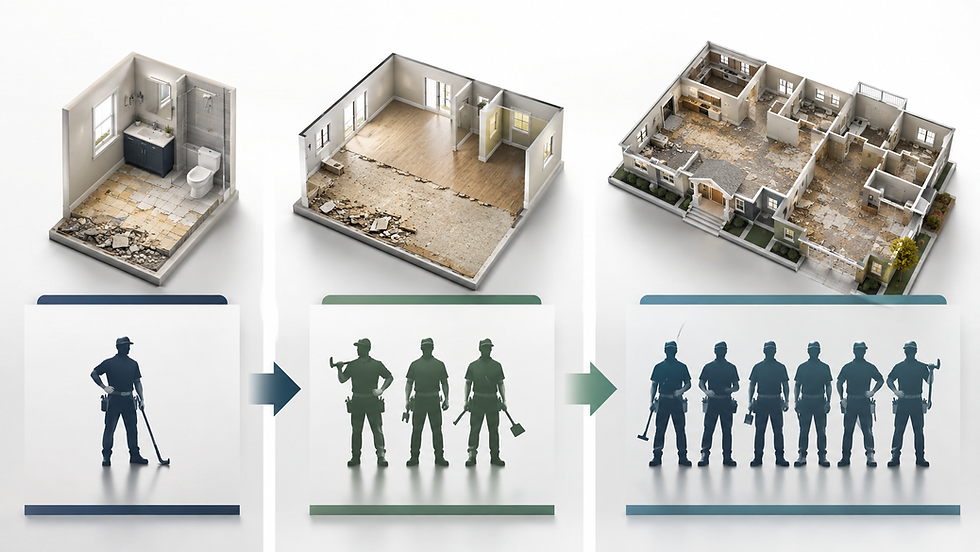
Project Scope | Typical Crew Size | Typical Timeline |
Single bathroom or small room tile removal | 2 to 3 workers | Hours to a single day |
Kitchen or full-room selective demo | 2 to 3 workers | 1 to 3 days |
Whole-house flooring replacement (multiple rooms) | 3 to 6 workers | Several days depending on square footage |
Full interior gut demolition | 3 to 6 workers | 3 to 7 days for a 1,000 to 2,000 square foot home |
For most residential interior selective demo, whether that means a bathroom, kitchen, or partial remodel scope, a two to three person crew is standard and generally sufficient to run the necessary equipment, manage debris removal, and keep the project on pace. This crew size allows one worker to focus on active demolition using source-capture equipment while others manage debris clearing and prepare the next section of work, keeping the project moving efficiently without excessive overhead.
Why Larger Scopes Call for Larger Crews
A full interior gut of a home, or a whole-house flooring replacement spanning multiple rooms, generally benefits from a larger crew of three to six workers to complete the project within a reasonable timeframe. Without additional crew members, a large-scope project staffed at the same two to three person level as a single-room job would simply take proportionally longer, which is often not the tradeoff homeowners or property managers want when the goal is completing a whole-house renovation within a specific window.
Why Crew Size Is Not Simply About Square Footage
While square footage is a meaningful factor, it is not the only variable that determines appropriate crew size. Material type matters significantly: dense natural stone or thick mortar beds slow the pace of work regardless of crew size, meaning additional workers help more with parallel tasks like debris management than with the core grinding or chipping work itself, which is often bottlenecked by the equipment rather than available hands. Projects requiring careful work around fixtures, plumbing, or suspected hazardous materials also benefit from a smaller, more specialized crew working methodically rather than a larger crew moving quickly, since precision matters more than speed in these scenarios.
The Risk of Both Under-Staffing and Over-Staffing
A crew that is genuinely too small for a project's scope risks an extended timeline that can cascade into delays for the trades scheduled to follow, particularly on projects with tight turnaround windows like apartment unit turnovers or vacation rental scheduling gaps.
Conversely, an oversized crew for a small, contained project does not meaningfully accelerate a job that is fundamentally limited by equipment throughput or careful, methodical work requirements, and simply adds unnecessary cost without a proportional benefit to the timeline.
How to Evaluate a Contractor's Proposed Crew Size
When discussing crew staffing with a demo contractor, useful questions include how many workers will be on-site for the specific scope, whether the timeline estimate reflects that crew size realistically, and whether the crew size might change if unexpected conditions, such as thicker-than-expected mortar or subfloor damage, are discovered mid-project. A contractor who can speak specifically to crew staffing relative to the actual project scope, rather than offering a generic answer, is generally providing a more accurate and reliable timeline estimate.
What the Right Crew Size Delivers

A properly staffed flooring demo project completes within the timeline the crew size was designed to support, with source-capture equipment running efficiently, debris managed continuously throughout the work rather than accumulating, and the subfloor delivered flat, clean, and ready for the next phase without unnecessary delay from either under-staffing or coordination overhead from an oversized team.
DustFree PNW matches crew size to project scope across our Central Oregon service areas. You can review our work on our Google Business Profile or get a free quote for your project.
Final Thoughts
Most residential flooring and tile demo projects are efficiently handled by a two to three person crew, with larger scopes like whole-house replacements or full interior gut demolition calling for a larger team of three to six workers. Crew size should match the actual scope, material type, and timeline needs of a specific project rather than a one-size-fits-all staffing approach. Get a free quote from DustFree PNW.
FAQ
What Size Crew Is Needed for Flooring Demo on a Typical Project?
Most residential flooring and tile demo projects, including single-room and bathroom scopes, are efficiently handled by a two to three person crew.
Does a whole-house flooring replacement need a bigger crew?
Yes, typically. Whole-house or full interior gut projects generally benefit from a larger crew of three to six workers to complete the work within a reasonable timeframe.
Does crew size depend only on square footage?
No. Material type, mortar thickness, and the need for careful work around fixtures or suspected hazards all shape the appropriate crew size beyond simple square footage.
Can too small a crew delay a flooring demo project?
Yes. Under-staffing a project relative to its scope extends the timeline, which can cascade into delays for trades scheduled to follow, particularly on projects with tight turnaround windows.
Does a bigger crew always finish a job faster?
Not necessarily. Small, contained projects are often limited by equipment throughput or careful, methodical work requirements, meaning an oversized crew adds cost without proportionally speeding up the timeline.
Does DustFree PNW match crew size to project scope in Central Oregon?
Yes. DustFree PNW staffs projects with crew sizes matched to the actual scope across Central Oregon. Contact us for a free quote.


Comments