
Slate Removal: What Makes It Unique Compared to Other Stone Floors
TL;DR: Slate has a natural cleavage structure that causes it to split along flat planes rather than fracturing randomly like granite or porcelain. This makes slate removal somewhat easier per tile than denser stone types, but the thick mortar bed typically used to level its irregular surface, and the silica dust generated by both the stone and the mortar, still require professional dust control throughout the process.

Key Takeaways
Slate has a natural cleavage that allows it to split along flat planes when pried, making individual tile removal somewhat faster than removing denser stone types like granite or quartzite.
Slate's natural surface irregularity requires a thicker mortar bed to level the installation, and this mortar bed is often the most time-consuming phase of the removal job.
Slate contains silica from its clay mineral composition and generates crystalline silica dust during removal that requires source-capture control in occupied homes.
Slate tiles can vary in thickness by up to a quarter inch from tile to tile within the same installation, making the mortar bed beneath them uneven in depth and more labor-intensive to grind uniformly.
Some slate installations in older Central Oregon homes used irregular or hand-cut slate with even greater thickness variation and wider grout joints, both of which add to the mortar volume to be removed.
Slate flooring appears in Central Oregon homes most commonly in entryways, bathrooms, and transitional spaces where its earthy tones and natural texture suit the outdoor-to-indoor aesthetic common in the region. When these installations are updated, slate removal is a medium-difficulty natural stone job where the surface tile phase moves reasonably quickly relative to granite, but the mortar cleanup phase that follows is the main determinant of total project time.
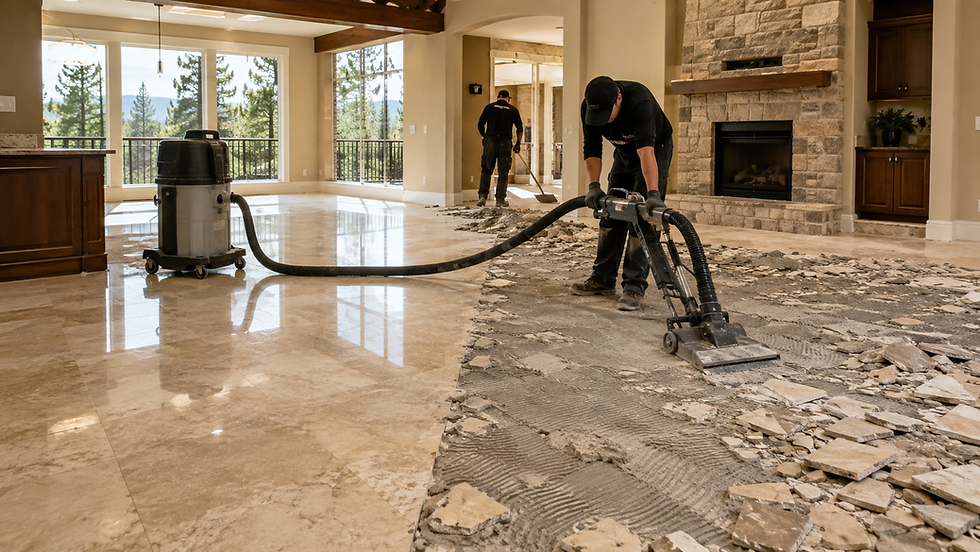
DustFree PNW's dust-free tile removal service covers slate and natural stone removal across Central Oregon. Here is what distinguishes slate from other stone types and what the full removal scope involves.
How Slate's Cleavage Structure Affects Removal

Stone Type | Fracture Behavior | Removal Speed (Surface Phase) | Mortar Bed Typical Depth |
Slate | Cleaves along flat planes | Medium, faster than granite | Three-quarter to one and a half inches |
Granite | Dense, chips in sections | Slow, resists each impact | Three-quarter inch thinset to mortar bed |
Travertine | Porous, breaks in chunks | Medium | One to one and a half inches |
Ceramic | Chips and pries in sections | Fast relative to stone | Quarter inch thinset |
Because slate cleaves rather than fractures randomly, prying under the tile edge often releases large sections of the tile in relatively intact pieces. This can make the tile surface removal phase faster and generate slightly less airborne dust per tile than chipping dense granite. However, the cleavage also means slate tends to leave thin slivers of stone bonded into the mortar at the adhesive face, which complicates the mortar bed cleanup because the stone fragments embedded in the mortar resist grinding differently than the mortar itself.
The Mortar Bed Under Slate: The Main Challenge
Slate's natural thickness variation, often a quarter inch or more from tile to tile within the same floor, requires a mortar bed installation to level the surface properly. The installer adjusts the mortar bed depth under each tile to compensate for the stone's irregular back face, which means the mortar bed depth varies across the floor. Some areas may have three-quarter inch of mortar while adjacent areas have an inch and a half, creating an uneven grinding challenge after the slate is removed.
This uneven mortar depth is why slate jobs sometimes take longer to grind than travertine jobs of similar square footage, even though the travertine mortar bed may be nominally the same depth. DustFree PNW's dedicated thinset removal service covers this mortar grinding phase for slate and stone jobs with source-capture equipment across Central Oregon.
Silica Dust From Slate Removal
Slate is a metamorphic rock composed of clay minerals including chlorite and muscovite, which contain silica as part of their mineral structure. While slate's silica content is lower than granite or quartzite, it still releases crystalline silica during chipping and the mortar grinding phase generates silica from both the cement mortar and the concrete slab surface. Source-capture equipment is required throughout slate removal in occupied homes just as it is for all other stone and tile types.
What Slate Removal Looks Like When Complete
A completed slate removal delivers a concrete slab that is flat, uniformly clean of mortar residue, and free of all stone fragments and debris. The depth variation in the mortar bed means additional passes may be required in deeper areas to achieve uniform flatness across the slab. All debris leaves the property as part of the completed scope.

DustFree PNW covers slate removal across our Central Oregon service areas. Review our work on our Google Business Profile or get a free quote.
Final Thoughts
Slate removal is a medium-difficulty natural stone job where the surface tile phase moves relatively quickly due to the stone's cleavage structure, but the uneven mortar bed cleanup phase is where most of the project time is concentrated. Source-capture dust control throughout both phases keeps the home clean and the project on schedule. Get a free quote from DustFree PNW.
FAQ
Is slate tile easier to remove than granite?
The surface tile removal phase is generally faster for slate because its natural cleavage allows it to split along flat planes rather than resisting each chisel impact the way dense granite does. The mortar bed cleanup phase is similar in difficulty.
Why does slate require such a thick mortar bed?
Slate tiles vary in thickness by up to a quarter inch from tile to tile. Installers use varying mortar bed depths to level each tile, resulting in an uneven mortar depth across the floor that requires careful grinding to remove uniformly.
Does slate removal create silica dust?
Yes. Slate contains silica minerals in its clay composition, and the mortar bed beneath it is cement-based. Both generate crystalline silica dust during removal, requiring source-capture control in occupied homes.
Does DustFree PNW remove slate floors in Central Oregon?
Yes. DustFree PNW handles slate and natural stone removal with source-capture equipment across Central Oregon. Contact us for a free quote.


Comments