
Marble Tile Removal: What to Know Before Demo Begins
TL;DR: Marble is a dense metamorphic stone with high silica content that fractures into sharp, heavy fragments during removal. Its brittleness under impact and the thick mortar bed typically used to set it make marble tile removal physically demanding work that generates significant silica dust from both the stone and the setting material.
Key Takeaways
Marble is a metamorphic limestone with high silica content from quartz and mineral inclusions. Breaking it during removal generates concentrated silica dust that requires source-capture control in occupied homes.
Marble fractures unpredictably under impact into large, sharp-edged fragments that are heavier than ceramic or porcelain fragments and require careful handling during removal and debris collection.
Marble is almost always set over a mortar bed rather than standard thinset, adding a thick second layer that must be ground off the slab after the stone surface is removed.
The polished surface of marble tiles creates a weaker bond at the adhesive interface in some installations, but this does not make the mortar bed underneath easier to remove.
Marble removal debris is heavy, typically eight to fourteen pounds per square foot installed, requiring hauling equipment sized appropriately for stone debris loads.
Marble tile appears in Central Oregon homes as a premium flooring and wall material in bathrooms, entryways, and living rooms. Its polished surface and distinctive veining make it visually distinctive. Its behavior during removal, dense, heavy, sharp when fractured, and high in silica dust generation, makes it one of the more demanding natural stone demo jobs in a residential remodel.
DustFree PNW's dust-free tile removal service covers marble and natural stone removal across Central Oregon with source-capture equipment. Here is what the process involves and what to confirm before any marble demo begins.
What Makes Marble Different From Other Stone Types

Characteristic | Marble | Granite | Ceramic |
Material type | Metamorphic limestone | Igneous rock | Fired clay |
Silica content | Moderate to high (inclusions) | Very high (60 to 80%) | Moderate |
Fracture behavior | Brittle, large sharp fragments | Dense, chips in sections | Chips and breaks in sections |
Weight per sq ft | 8 to 14 lbs installed | 10 to 15 lbs | 4 to 7 lbs |
Typical mortar bed | Three-quarter inch to one inch | Three-quarter inch to one inch | Quarter inch thinset |
Marble's brittleness is its defining removal characteristic. Where granite and porcelain resist chipping and release slowly under impact, marble tends to fracture in larger sections once a crack propagates through the stone. These larger fragments are heavier per piece than ceramic or porcelain chips, create a higher fall-impact risk during collection, and require more careful debris handling to prevent secondary damage to the subfloor or adjacent surfaces.
The Mortar Bed Under Marble
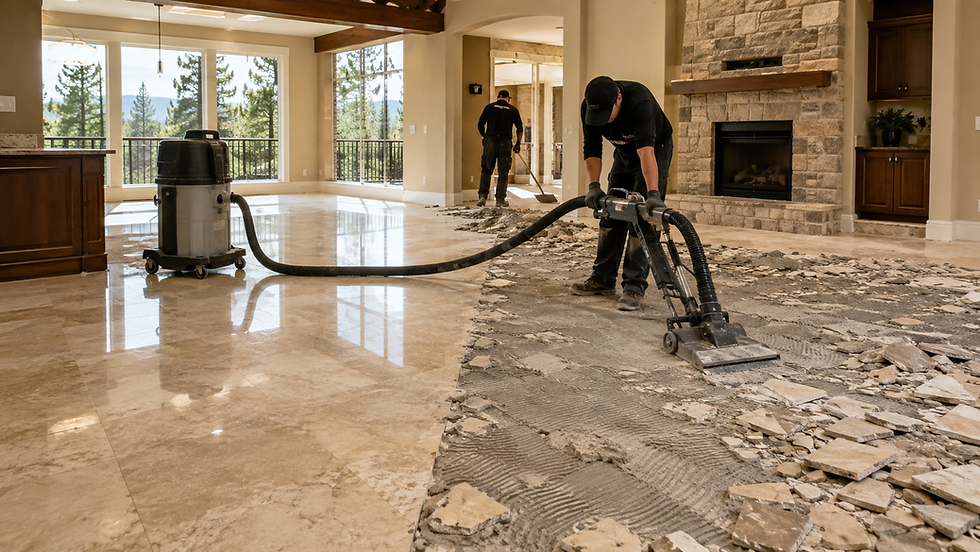
Marble is almost always installed over a mortar bed rather than standard thinset, for the same reason as travertine: the natural variation in stone thickness requires a thicker, more flexible setting system to achieve a level floor. The mortar bed under marble is typically three-quarters to one inch thick. After the marble surface is removed, this mortar layer must be chipped and ground off the slab before new flooring can go down.
DustFree PNW's dedicated thinset removal service covers this mortar grinding phase with source-capture equipment across Central Oregon.
Silica Dust From Marble Removal
Marble contains silica from quartz veins and mineral inclusions that are common in metamorphic rock. While marble's primary mineral is calcium carbonate rather than quartz, the silica-containing inclusions are dispersed throughout the stone body and are released during fracture and chipping. The mortar bed beneath marble is cement-based and also high in silica. Both materials require source-capture control throughout the entire removal process.
What Complete Marble Removal Looks Like
A finished marble tile removal leaves the concrete slab flat, uniformly clean of mortar residue, with all marble fragments and mortar debris hauled from the property. The clean slab should meet the flatness tolerance of the new flooring system and be free of any silica dust contamination on adjacent surfaces in the home.

DustFree PNW covers marble removal across our Central Oregon service areas. Review our work on our Google Business Profile or get a free quote.
Final Thoughts
Marble tile removal is a two-phase job, the marble surface and the mortar bed, with significant silica dust and debris weight generated across both phases. Source-capture equipment from the first chisel impact through the final grinding pass is the approach that keeps the home clean and the installation crew working on a properly prepared slab. Get a free quote from DustFree PNW.
FAQ
Is marble tile removal similar to ceramic tile removal?
It is more demanding. Marble is heavier, fractures into larger sharp fragments, is almost always set over a thicker mortar bed, and generates silica dust throughout every phase of removal.
Does marble removal generate silica dust?
Yes. Marble contains silica mineral inclusions, and the mortar bed beneath it is cement-based. Both generate crystalline silica dust during chipping and grinding, requiring source-capture control in occupied homes.
Is mortar bed removal included in marble tile quotes?
A complete scope should include it. Confirm explicitly before booking. Marble is almost always set over a thick mortar bed that must be removed before new flooring can go down.
Does DustFree PNW remove marble tile in Central Oregon?
Yes. DustFree PNW handles marble and natural stone removal using certified source-capture equipment across Central Oregon. Contact us for a free quote.


Comments