
Insurance Restoration Flooring Removal After Water or Fire Damage
TL;DR: Insurance-covered flooring removal after water or fire damage requires documentation at every stage: photos and video before any material is disturbed, a clear timeline of when damage was discovered, presence during the adjuster's walkthrough, and a final report from the restoration crew confirming the work was completed correctly. Mold can begin developing within 24 to 48 hours of water exposure according to the EPA, which means acting quickly on both mitigation and documentation protects both the property and the claim itself.

Key Takeaways
Documenting damage thoroughly before any flooring removal begins, through photos, video, and written notes on when the damage was discovered, is the foundation of a successful insurance claim.
Mold can begin developing within 24 to 48 hours of water exposure, making prompt reporting and mitigation important for both property protection and claim timing.
Homeowners and property managers benefit from being present during the insurance adjuster's walkthrough, since this is the opportunity to point out hidden damage and explain why certain materials must be removed rather than dried in place.
A restoration partner not affiliated with the insurance company can advocate for the homeowner's interests more directly than an insurer-recommended vendor, particularly for specialized flooring types like hardwood.
Retaining detailed invoices, change orders, and a final completion report from the flooring crew provides the documentation needed if a claim is disputed, underpaid, or requires appeal.
Flooring removal after water or fire damage carries a dimension that a standard remodel project does not: an active insurance claim depending on documentation, timing, and process being handled correctly at every stage. Rushing straight into demolition without first capturing thorough documentation, or working with a restoration partner unfamiliar with insurance-specific requirements, can complicate or weaken a claim even when the underlying damage and repair scope are entirely legitimate.
DustFree PNW's flooring removal service handles insurance restoration projects across Central Oregon with attention to the documentation these claims require. Here is what the process should look like from discovery through completed restoration.
Why Speed Matters Immediately After Discovering Damage
Water damage creates a genuine time pressure that goes beyond simple property protection. According to EPA guidance, mold can begin developing within 24 to 48 hours of water exposure, which means the window between discovering damage and taking action directly affects both the extent of secondary damage and the strength of a subsequent insurance claim. Reporting damage promptly to the insurance company, alongside taking immediate mitigation steps like removing standing water and running dehumidifiers, protects the property while the claims process gets underway.
Documentation That Protects Your Claim
Documentation Type | What to Capture | Why It Matters |
Photos and video | Multiple angles, close-ups, and wide shots of all affected areas before any removal begins | Provides visual proof of damage extent that photos alone sometimes cannot fully explain |
Written notes and timeline | When damage was discovered, what emergency steps were taken, and who was contacted | Connects the timeline in ways photos cannot, such as clarifying when a leak likely started |
Professional reports | Plumber, contractor, or restoration company assessment documenting the cause and extent | Establishes the true timeframe and cause of damage for the insurer's review |
Receipts and invoices | All restoration costs, change orders, and any temporary housing or lost-rent documentation | Tracks what the insurer has paid versus out-of-pocket costs for reimbursement |
Written notes deserve particular attention because they capture context photos alone cannot convey. A stain on a ceiling does not by itself indicate when a leak started, and a wet floor does not show whether the water came from a pipe, a storm, an appliance, or a sewage backup. Detailed, dated notes connecting these dots are frequently what allows an adjuster to understand the full sequence of events rather than reconstructing it after the fact from visual evidence alone.
Being Present During the Adjuster's Walkthrough
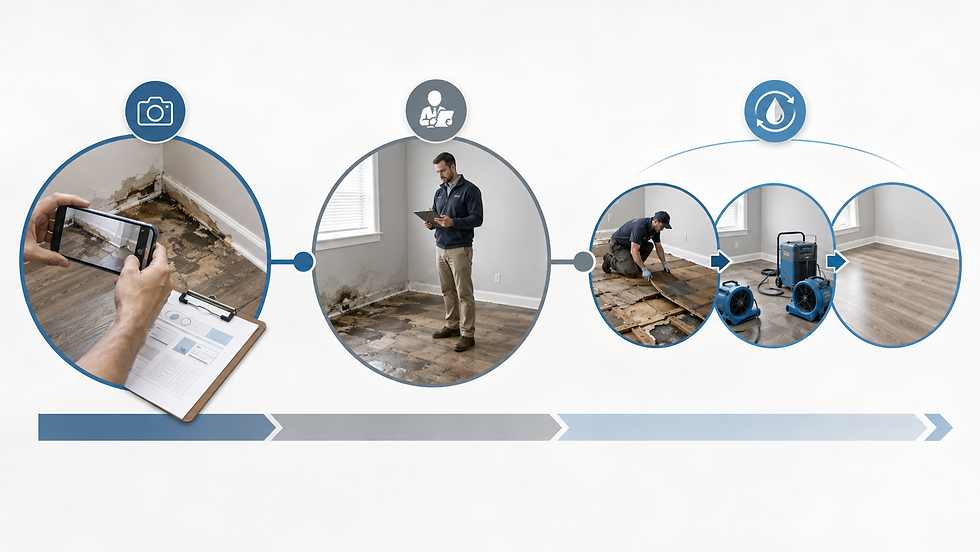
The insurance adjuster's visit functions essentially as a professional walkthrough where the homeowner or property manager serves as the guide. Walking the adjuster through the full path the water traveled, not just the most visibly damaged areas, and specifically pointing out hidden risks behind cabinets, under flooring, or inside closets, ensures the full scope of damage is captured in the adjuster's assessment rather than only the portions immediately visible. This is also the appropriate moment to reference the restoration company's scope of work, explaining why certain materials, such as saturated carpet padding or wet drywall, need to be removed entirely rather than simply dried in place.
Choosing a Restoration Partner Not Tied to the Insurer
Insurance companies frequently recommend a preferred vendor list for restoration work, and while these vendors can be competent, they are not always the best fit for every situation, particularly for specialized flooring types like hardwood where technique and material knowledge matter significantly for the final outcome. A restoration and flooring partner not affiliated with or financially beholden to the insurance company is generally positioned to advocate more directly for the outcome the homeowner actually wants, rather than an approach optimized primarily to minimize the insurer's payout. Homeowners are generally free to choose their own contractor for restoration work, and using the insurance company's estimate as a negotiating baseline with an independent contractor is a common and reasonable approach.
What Happens to Flooring That Cannot Be Salvaged
Once the claim moves from emergency mitigation into full restoration, unsalvageable materials including wet drywall, saturated carpet padding, and warped or delaminated wood flooring are removed as part of the restoration scope. For engineered wood floors specifically, water trapped beneath the surface due to the glued-down installation method can cause buckling, discoloration, and delamination that is not always immediately obvious from the surface, meaning a full assessment after flooring removal is often necessary to determine the actual extent of damage before proceeding.
Drying and Rebuilding After Removal
After removing unsalvageable materials and confirming the extent of damage, structural drying using dehumidifiers and air movers proceeds before any new flooring or finish work begins. This drying phase should be verified through moisture testing rather than assumed complete based on a visual check, since installing new flooring over a subfloor that is not genuinely dry risks the same mold and moisture problems recurring beneath the new installation. Only once drying is confirmed does the rebuild phase, including new flooring, baseboards, and finish work, proceed.
What a Complete Insurance Restoration Flooring Removal Delivers

A properly handled insurance restoration flooring removal project includes thorough documentation at each stage, clear communication with the adjuster about scope and hidden damage, removal of unsalvageable materials, verified drying before rebuild, and a final completion report the homeowner can retain alongside their claim records. This documentation protects the homeowner not just during the initial claim but in the event of any future dispute or reopened claim related to the same damage.
DustFree PNW handles insurance restoration flooring removal across our Central Oregon service areas, providing the documentation homeowners and property managers need for their claims. You can review our work on our Google Business Profile or get a free quote for your project.
Final Thoughts
Insurance restoration flooring removal succeeds when documentation happens at every stage: before removal begins, during the adjuster's walkthrough, throughout the restoration process, and at final completion. Acting quickly given mold's 24 to 48 hour development window, choosing a restoration partner who advocates for your outcome, and retaining thorough records throughout are what protect both the property and the claim. Get a free quote from DustFree PNW.
FAQ
How quickly should I document damage before flooring removal?
Immediately, before any material is disturbed. Photos, video, and written notes on when damage was discovered form the foundation of a strong insurance claim.
Why does mold timing matter for insurance-covered flooring removal?
Mold can begin developing within 24 to 48 hours of water exposure according to EPA guidance, making prompt reporting and mitigation important for both property protection and claim strength.
Do I have to use the insurance company's recommended restoration contractor?
No. Homeowners generally can choose their own contractor for restoration work, using the insurer's estimate as a negotiating baseline rather than being limited to a preferred vendor list.
Should I be present during the insurance adjuster's visit?
Yes, if possible. Being present allows you to point out hidden damage and explain why certain materials need to be removed rather than dried in place.
What happens to flooring that cannot be salvaged after water damage?
Unsalvageable materials like saturated padding, warped wood, and wet drywall are removed as part of the restoration scope, followed by structural drying and moisture verification before new flooring is installed.
Does DustFree PNW handle insurance restoration flooring removal in Central Oregon?
Yes. DustFree PNW provides documented flooring removal for insurance restoration claims across Central Oregon. Contact us for a free quote.



Comments