
Dust-Free Remodeling: What It Actually Means and Why It Matters
TL;DR: Dust-free remodeling is not a claim that a remodel produces zero dust. It is a specific approach to the most hazardous dust generated during demo phases, particularly crystalline silica dust from tile, stone, and mortar removal, where source-capture equipment prevents that dust from becoming airborne rather than trying to manage it after it is already in the air.
Key Takeaways
Not all remodeling dust is equally hazardous. Drywall dust, sawdust, and paint are nuisances. Crystalline silica dust from tile, stone, and mortar removal is classified by OSHA as a known human carcinogen with a permissible exposure limit.
Dust-free remodeling specifically addresses the demo phases where silica dust is generated, not every phase of a remodel. Framing, drywall, and painting still produce dust that requires containment, not source-capture.
The critical distinction between dust-free and dustless is where capture happens. Dustless captures some dust after it is airborne; source-capture captures it at the tool before it becomes airborne.
HVAC systems in occupied homes are the primary pathway for silica dust to spread beyond the work zone. Source-capture demo prevents contamination of the duct system before it starts.
Choosing dust-free tile and flooring demo for a remodel in an occupied home is the decision that determines whether the rest of the remodel happens in a clean environment or one where silica residue lingers for months.
Dust-free remodeling is a term that gets used in different ways, and the confusion between what it means and what it does not mean is worth clearing up before a homeowner makes hiring decisions based on it. A remodel that produces zero dust at any phase does not exist. What does exist is a meaningful difference in how the most hazardous dust generated during demo phases is handled, and that difference determines whether the home's air quality and HVAC system stay clean through the project.
DustFree PNW's dust-free tile removal service applies to the specific phases where silica dust is generated during remodel demo across Central Oregon. Here is what dust-free remodeling actually covers and what it does not.
Which Remodeling Tasks Produce the Most Dangerous Dust
A full home remodel produces dust from many sources. Most of that dust is a cleanup problem, not a health hazard at typical home renovation exposure levels. A meaningful subset of remodeling tasks produces dust that is regulated by OSHA with specific exposure limits because of documented health risks from chronic inhalation.

Remodeling Task | Primary Dust Type | Health Risk Level | Dust-Free Source-Capture Needed? |
Tile and stone floor removal | Crystalline silica | Significant — OSHA regulated | Yes |
Thinset and mortar grinding | Crystalline silica and concrete | Significant — OSHA regulated | Yes |
Drywall cutting and sanding | Calcium sulfate dust | Low to moderate, nuisance level | Containment and filtration |
Wood cutting (framing, trim) | Wood dust | Low to moderate | Containment and filtration |
Carpet removal | Particulate, allergens | Low | Standard cleanup |
Painting and finishing | VOCs, particulate | Low to moderate depending on product | Ventilation and PPE |
Tile removal and mortar grinding are the two phases in any remodel where source-capture dust control is most critical, because these tasks generate crystalline silica dust at concentrations that can exceed OSHA's permissible exposure limit within minutes of starting work without capture at the source. All other remodeling dust categories are meaningfully less hazardous and can be addressed with containment, filtration, and cleanup rather than source-capture equipment.
Why Containment Alone Is Not Enough for Silica Dust
The standard approach to construction dust in a home remodel is containment: plastic sheeting over doorways, vents covered with tape, and a cleanup at the end of the day. For drywall dust and sawdust, this approach is adequate. For crystalline silica dust from tile removal, it is not.
Silica dust particles are fine enough to pass through gaps in plastic sheeting, move through HVAC systems that run during the day, and remain airborne in a room for hours after the demo work stops. Standard MERV 8 furnace filters, the most common residential filter grade, do not capture particles fine enough to include all respirable silica particulate. Once silica dust enters the HVAC duct system, it is redistributed throughout the home each time the system cycles on, exposing occupants in rooms far from the work zone.
Source-capture equipment solves this by removing the dust before it can become airborne in the first place. The vacuum is integrated into the demo tool itself, so dust is captured at the chisel or grinding head contact point before it has any pathway to the air in the room. No containment system catches dust that was never released.
The Dustless vs Dust-Free Distinction in Remodeling
Many contractors advertise their tile removal as dustless, and some homeowners assume this is the same as dust-free. It is not. Dustless removal means a vacuum system runs near the work, capturing dust after it has already left the tool contact point and become airborne. This reduces visible dust meaningfully compared to no dust control at all, but it allows a significant portion of fine silica particulate to escape the vacuum and spread through the room and HVAC before being captured.
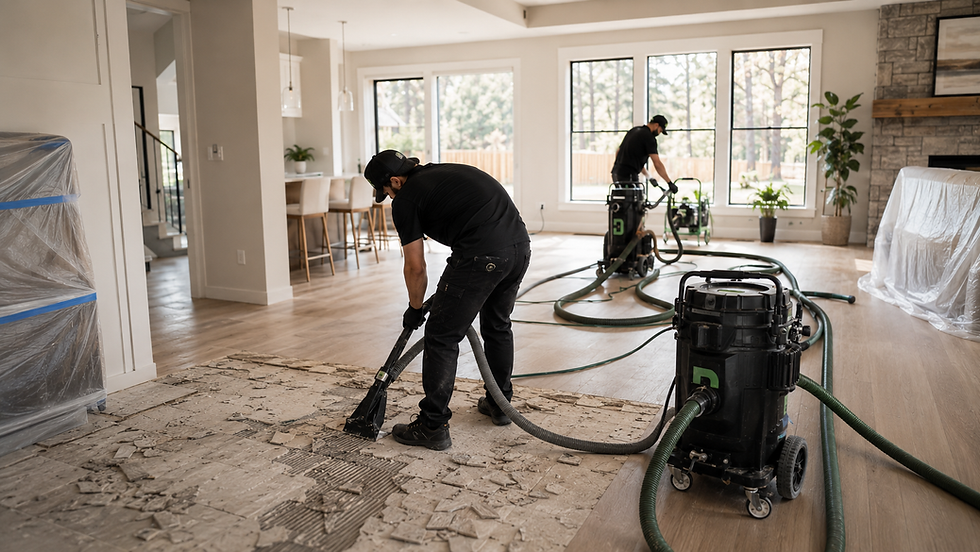
Dust-free floor removal uses advanced source-capture equipment that integrates a high-powered vacuum directly with the removal tool, capturing dust at the point of contact before it becomes airborne. Unlike traditional dust-control methods, this process prevents harmful particles from spreading throughout the home, helping protect indoor air quality, nearby surfaces, and the HVAC system during flooring demolition.
What Dust-Free Remodeling Looks Like in Practice
During a professional source-capture tile removal project, the contractor uses specialized dust-control equipment that captures debris directly at the tool’s point of contact. Because dust is contained before it becomes airborne, extensive plastic sheeting is typically unnecessary, and the surrounding rooms remain clear of visible dust and haze throughout the floor removal process.
Countertops, baseboards, and HVAC grilles in the adjacent space do not accumulate a layer of fine dust that requires cleaning before the next trades arrive. The HVAC system does not need to be professionally cleaned after the tile demo is complete.

The thinset grinding phase that follows tile removal requires the same source-capture approach. DustFree PNW's thinset removal service applies source-capture equipment to the mortar grinding phase across Central Oregon. You can review our work on our Google Business Profile or get a free quote for your remodel demo scope.
Final Thoughts
Dust-free remodeling is a meaningful approach applied to a specific set of the most hazardous demo tasks, not a claim that the entire remodel produces zero dust. For homeowners in Central Oregon planning a remodel that includes tile or stone removal, choosing source-capture certified demo for those phases is the decision that keeps silica dust out of the HVAC system, off the surfaces, and out of the air during the most critical phase of the project. Get a free quote from DustFree PNW.
FAQ
Does dust-free remodeling mean no dust at all?
No. It means the most hazardous dust, crystalline silica from tile, stone, and mortar removal, is captured at the source before it becomes airborne. Other remodeling phases still produce dust that is managed through containment and filtration.
Which remodeling tasks require dust-free source-capture equipment?
Tile and stone removal and thinset or mortar grinding are the two phases where source-capture equipment is most critical. These tasks generate crystalline silica dust at OSHA-regulated levels that containment alone cannot adequately manage in an occupied home.
What is the difference between dustless and dust-free tile removal?
Dustless captures dust after it has become airborne using a nearby vacuum. Dust-free captures it at the tool contact point before it becomes airborne. The result for the home's air quality and HVAC system is meaningfully different.
Why does silica dust contaminate HVAC systems?
Silica particles are fine enough to remain airborne for hours and pass through containment gaps. Floor-level HVAC returns in kitchens and bathrooms pull airborne dust into the duct system, distributing it throughout the home each time the system cycles on.
Does every remodel phase need dust-free equipment?
No. Drywall, carpentry, and painting dust can be managed with standard containment, filtration, and cleanup. Source-capture is specifically needed for the silica-generating demo phases: tile removal and mortar grinding.
Does DustFree PNW provide dust-free remodeling demo services in Central Oregon?
Yes. DustFree PNW provides professional tile removal and thinset grinding across Central Oregon using advanced source-capture equipment that controls dust at the point of contact and helps protect indoor air quality, surrounding surfaces, and HVAC systems. Contact us for a free quote.


Comments